

SHM Studio presents a selection of the most effective tools for 2025, designed to perfect the technical performance of your website and guarantee an impeccable user experience, key factors for digital success.
- Code Validation and Quality: Tools like W3C Validator are essential for analyzing HTML code stability and correcting structural errors that could compromise site usability and speed.
- Link Management: Maintaining a healthy site requires using tools like W3C Link Checker and Broken Link Checker (for WordPress) to promptly identify and repair broken links that harm navigation and SEO.
- Accessibility and Visual Optimization: Ensuring accessibility for all users via Wave and reducing image size with Optimizilla without losing quality are fundamental steps to improve inclusiveness and loading speed.
- Cross-Device Testing: Platforms like BrowserStack allow us to verify the site's rendering across a wide range of browsers and devices, ensuring a consistent and optimized experience for every visitor.
for optimize your website and to respect SEO rules, many parameters independent of keywords must be taken into consideration, such as ease of navigation, speed, and the absence of code errors in programming.
In this article we will examine some tools that we at SHM Studio, a web agency in Milan, use to improve SEO and optimize our clients' websites. A well-designed, easily navigable, and fast website leads to concrete results:
- User experience improvement : well-designed tools optimize user navigation, making interaction with site content more intuitive.
- Reduction of bounce rate : optimal usability reduces the likelihood that users will leave the site, helping to maintain a low bounce rate and increase their engagement.
- Increase in conversions : optimized usability simplifies the user's journey towards the desired action, such as a purchase or newsletter signup, positively influencing the conversion rate.
- Building a positive reputation : a website with high-quality usability helps build a positive reputation for the brand.
- Increase in competitiveness : offering optimal usability can set the website apart from the competition, thus increasing its market competitiveness.
Optimize your website , the best tools to use in 2026
Very often, during the optimization of a website , you risk overlooking a whole series of secondary elements that nevertheless have a significant impact on overall performance.
An example is programming code, sometimes poorly structured or uncompressed, which can significantly slow down page loading. Similarly, broken links and image weight are often ignored, but they are crucial to ensure optimal experience and performance. Fortunately, there are dedicated tools that simplify checking these aspects.
Let's see in detail what they are.
W3C Validator

Most companies use W3C Validator to maintain the high quality of their website. Its main feature is the verification of HTML code stability and, above all, attention to the overall usability of the site.
By entering the URL of the page to examine, the software performs a quick analysis and provides a report of strengths and weaknesses. By identifying any usability vulnerabilities, you can specifically intervene on the affected sections, minimizing issues that could negatively impact the experience of users visiting your web pages.
W3C Link Checker

W3C Link Checker it is a powerful tool that allows you to quickly examine all the pages of your website, identifying broken hyperlinks or those that lead to pages irrelevant to your business.
If your goal is optimize your website , this tool can be particularly useful for identifying unindexed links, especially if there is an important informational component with many backlinks. Also for e-commerce and other platforms with limited use of Backlinks , a quick check on existing links can bring significant benefits.
Broken link checker

If your site uses the WordPress CMS, this plugin is a formidable ally. Broken link checker is a tool designed to constantly monitor the links present on your site, identifying broken or non-functioning ones.
Broken links can result from changes in the URL of a linked page or from the cessation of activity of external websites. The plugin Broken Link Checker makes identifying broken and non-working links an automated and efficient process, extremely simple to use.
Wave

You can use Wave to evaluate the accessibility of your website. From a technical standpoint, this tool is designed to assist people with disabilities by identifying accessibility errors and adhering to WCAG guidelines to ensure an optimal user experience while browsing your site.
For example, Wave can automatically identify issues such as inadequate color contrast or missing alternative descriptions for images, thus providing you with useful suggestions to resolve these situations. You can integrate this tool into your search engine as an extension, allowing you to easily check alerts and structural issues in the code that can compromise the user experience.
This is a reliable and easy-to-install solution, featuring useful functionalities for any type of webpage.
Optimizilla

An extremely useful tool, especially if you have a website full of images. With just a few clicks, Optimizilla gives you the opportunity to optimize your site's images, avoiding the use of expensive and complex software like Photoshop.
Its great advantage lies in preserving image quality even after optimizing them: by uploading them directly from your desktop or via URL, you can in fact achieve high-quality results without having to spend too much time adjusting proportions and formats. This is an ideal solution if you are not familiar with the world of graphics and digital formatting.
BrowserStack

BrowserStack allows developers and testers to view and test the site on a wide range of devices and browsers, thus ensuring a consistent and optimal experience for all users, regardless of the device or browser used.
For example, a development team working on new graphics for a company website can use BrowserStack to ensure that the new design is optimized for user experience across a wide range of devices and browsers.
Before release, they can upload the website to various browser versions like Chrome, Firefox, Safari, and Internet Explorer on different devices, including desktops, tablets, and smartphones.
They can then examine it on each browser and device combination to identify any display, navigation, or performance issues. This allows making the necessary corrections before the official launch of the new design, ensuring that the site is optimized and works correctly on all devices and browsers used by their user base.
Microsoft Clarity

Microsoft Clarity is a powerful tool that can be extremely useful for optimizing your website. It allows you to gain a detailed view of user behavior on your pages, their interactions, and their navigation paths, helping you identify critical aspects and areas that could be optimized to improve the user experience and increase engagement.
For example, suppose you have a e-commerce website and you notice that many users abandon the cart during the checkout process.
Using Microsoft Clarity, you can view user session recordings to understand exactly where drop-offs occur, and identify any usability or navigation issues that might be the cause. With this information, you can make the necessary changes to your site to make the checkout process smoother and more intuitive.
Pingdom

Pingdom is a tool that allows you to monitor your website's performance, measuring page load times and identifying areas of the site that may require improving overall speed and efficiency.
For example, imagine running an e-commerce site and receiving reports from users complaining about slow loading times during the checkout process. Using Pingdom, you can run a speed test and identify which specific elements are slowing down page loading, such as unoptimized images or heavy scripts.
With this information, you can make the necessary changes to optimize pages, maximizing the possibility of conversions.
GTMetrix

GTMetrix It is a tool we often use to check the “health status” of our clients' websites. In fact, it provides us with a detailed analysis of the performance of the website in question by evaluating crucial aspects such as page loading time, file sizes, and server response speed. Through a series of metrics and recommendations, GTmetrix also offers valuable information to improve the user experience, and consequently achieve better rankings in search engines. It also identifies critical issues that slow down page loading and gives us specific suggestions on how to fix them, such as image compression, reduction of JavaScript and CSS files, and caching optimization.
By using GTmetrix regularly, you can therefore constantly monitor your site's performance and implement corrections whenever necessary.
Screamingfrog
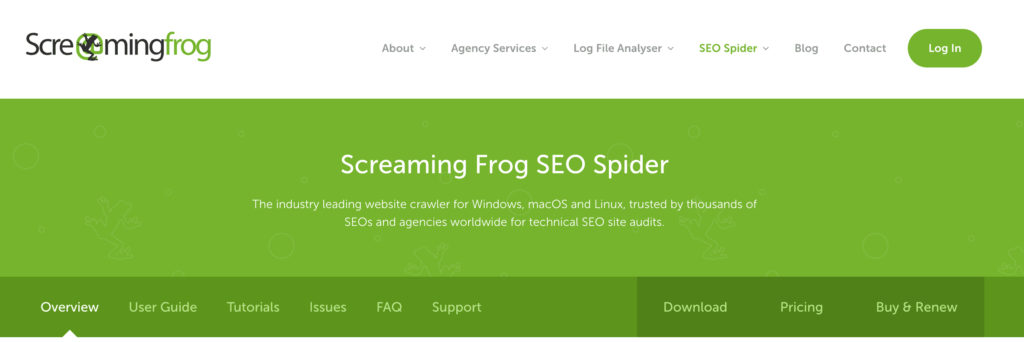
Screaming Frog it is not just a tool for monitoring page loading times, but a tool that through a deep scan of the site provides a wide range of data to fully understand its "state of health".
It allows you, for example, to identify a series of critical elements such as broken links, the number of words in resources, the presence or absence of title tags, 404 errors, 301 redirects, and, of course, page load times.
Using the data provided by the tool, you can organize the results into a table in descending order based on loading time and easily identify the pages that require the most improvements. This allows you to take targeted action, for example by optimizing images or reducing the number of scripts, in order to improve the overall performance of your website.
PageSpeed Insights

If you want to get a complete and detailed overview of your page's status, you won't be able to do without PageSpeed Insights . This tool is very well known by both developers and less experienced users because its results are easy to understand. By analyzing the loading time of individual pages on both mobile and desktop devices, Pagespeed Insights provides a wide range of useful information such as loading speed metrics, the time needed for page rendering, server response time, and total loading times. Furthermore, an in-depth performance analysis is provided regarding the display of visual content, such as images and videos present on the site.
Pagespeed Insights from Mountain View carefully evaluates your site and provides a complete list of necessary steps to optimize your website performance Not only does it list the interventions to be made, but it also provides valuable advice on practical actions to take, suggestions on WordPress plugins to implement, and recommendations on content to delve into. Thanks to it, therefore, you have all the necessary tools at your disposal to make your pages faster, more efficient, and high-performing.
If you find that your website is slow, you don't need to worry, because there is always room for improvement.
The In this article, we have reviewed some of the best tools of 2026 to optimize your website. From performance evaluation to fixing code errors, these tools offer a wide range of features. Thanks to them, you can improve the user experience and increase online visibility. How digital agency in Milan , SHM Studio regularly uses these tools to ensure excellent results for clients. We are here to help you optimize every aspect of your website and achieve your digital ambitions.
C contact us for a free consultation and discover how we can improve your website together to achieve maximum online success.
Comparative table of the best tools to optimize a website
| Tool | Specific use and main feature | Target companies/clients |
| W3C Validator | Check the HTML code and report markup errors to ensure technical stability and standards compliance | Companies with a corporate website or structured portals that need technical solidity and reliability |
| W3C Link Checker | Check internal and external links identifying broken links | Companies with blogs, magazines, or e-commerce sites with many pages and backlink |
| Broken Link Checker | Plugin that automatically monitors broken links on WordPress sites | SMEs and companies using WordPress as a CMS |
| WAVE | Analyze site accessibility by identifying WCAG errors and contrast or ALT tag issues | SMEs that must comply with accessibility regulations or operate in the public sector |
| Optimizilla | Compress images while maintaining good quality to improve loading speed | E-commerce, visual companies, and brands with heavy image usage |
| BrowserStack | Test the site across different real browsers and devices to check its compatibility | Companies with a broad and multi-device audience |
| Microsoft Clarity | Analyze user behavior through heatmaps and session recordings | E-commerce and conversion-oriented companies |
| Pingdom | Measure loading speed and identify elements that slow down the site | Digital companies and online shops where performance impacts revenue |
| GTmetrix | Provides detailed reports on technical performance and improvement suggestions | Companies with a structured SEO strategy and technical optimization needs |
| Screaming Frog | Perform a complete SEO audit of the site by identifying technical errors, redirects, and missing tags | Companies investing in advanced SEO and periodic technical audits |
| PageSpeed Insights | Evaluate mobile and desktop speed and analyze Core Web Vitals with practical suggestions | Businesses aiming for Google positioning and UX optimization |
FAQ on website optimization
1. Why is optimizing a website crucial for Google ranking?
Optimizing a site does not just mean making it faster, but improving its technical structure, accessibility, code quality, and user experience. Tools like PageSpeed Insights allow you to analyze performance and Core Web Vitals, factors that directly impact organic ranking. A slow site or one with technical errors penalizes both the user experience and visibility on search engines.
2. How much do broken links impact SEO?
Broken links compromise navigability and send negative signals to search engines. Tools like W3C Link Checker or Broken Link Checker help identify and quickly fix these issues, especially on sites with many pages or frequently updated content.
3. Is accessibility really important for private companies too?
Yes. Accessibility is not just for public bodies, but for all companies that want to expand their audience and improve user experience. Tools like WAVE allow you to check compliance with WCAG standards, identifying issues such as color contrast problems, images without ALT tags, and other critical issues that can limit site usability.
4. What is the difference between a speed test and a complete technical audit?
Speed tests, such as those performed with Pingdom or GTmetrix, analyze page loading times and performance. A comprehensive technical audit, on the other hand, also includes structural SEO scans with tools like Screaming Frog, which check meta tags, redirects, 404 errors, and URL structure.
Related articles
Discover more articles exploring similar topics, selected to offer you a more complete and stimulating perspective. Each piece of content is carefully chosen to enrich your experience.



























































