

- As a web agency in Milan, we'll show you what to do to rank better in SEO in 2024
- What factors determine your website's ranking in 2024?
- The 3 Main Areas of SEO
- Site Speed and User Experience
- Core Web Vitals: What They Are and Why They Matter
- On-Page SEO Optimization to Improve Your Organic Rankings in 2024
- Organic Search Rankings: How to Choose the Best Keywords to Stand Out on Google in 2024
- On-Page SEO: Creating Original, Valuable Content
- Off-Page SEO: Backlinks
- Social Media Marketing and SEO Rankings
- A Little Help with SEO in 2024: The 3 Best Tools to Use
SHM Studio presents the definitive guide to SEO in 2024, showing how combining Artificial Intelligence (SGE) with technical optimization is crucial to dominate search engines and give your brand visibility.
- Search Generative Experience (SGE): Google's evolution calls for content that doesn't just answer keywords but satisfies search intent, with multimedia formats and direct answers that anticipate how users will interact next.
- Core Web Vitals and UX: Loading speed, visual stability and interactivity (LCP, FID, CLS) are no longer optional. They are decisive ranking factors that directly affect your rankings and the user experience.
- Integrated Strategy: SEO success rests on three pillars: Technical (structure, sitemap, schema markup), On-Page (valuable content, headings, meta tags) and Off-Page (quality backlinks and domain authority).
- Innovation and Tools: To compete in 2024, you need advanced tools (like Google Search Console and SEMrush) and a strategy that keeps adapting to algorithm updates, built on original, authoritative content (EEAT).
SEO is a constant challenge, shaped by ongoing changes in search engines, and as a web agency in Milan, we know it well.
Search engines keep evolving in response to changes in how users search and to new digital technologies.
The recent launch of, for example, marks a turning point in optimizing and monitoring search results. It brings in a wider range of content and requires strategies to adapt, so they meet web users' intent more fully.
In other words, search results will no longer be limited to web pages. They will also include other types of content, such as text snippets, direct answers, images and videos. A website's visibility will be assessed more holistically, with every aspect analyzed in detail.

To keep your online presence truly effective, you'll need to update your SEO strategies and rules regularly. That helps you avoid search engine penalties and make the most of the new visibility opportunities SGE may offer. Staying on top of the latest trends is therefore essential for a site that ranks well, earns the right traffic and gets a good .
In this article, we'll look at the key factors for building SEO strategies that take these innovations into account, so you can truly compete in the 2024 digital market.
As a web agency in Milan, we'll show you what to do to rank better in SEO in 2024
With over, there's little need to ask why SEO ranking matters so much.
Google dominates online search, judging the relevance of results with sophisticated algorithms that understand context and search intent. Content isn't the only thing that determines rankings. Other factors count too, or as we call them in digital agency jargon, “rules.”
If you're reading this article, chances are you have a website or want to launch one, and you want it to rank well.
Well, let's start by saying that if you ignore these “rules,” you hurt your platform's visibility and its ability to get visits and convert. In other words, not ranking properly can spell failure for your business.
What factors determine your website's ranking in 2024?
As a web agency in Milan that has worked in SEO for several years, we know that in the past it was enough to “sprinkle” a few keywords here and there to hope for a good ranking, even on the first page.
Today the landscape is very different, and it takes a broader range of skills to assess all the factors that contribute to ranking.
Here they are:
- Keyword relevance: choose the right keywords for your target audience and use specific techniques to identify them.
- Technical SEO optimization: improve site speed, ensure mobile compatibility, adopt HTTPS so your site is secure in users' eyes too, create an XML sitemap and use a Robots.txt file.
- User Experience (UX): user engagement has a direct impact on rankings.
- On-Page optimization: optimize titles, headings (H2, H3, H4, etc.), meta tags, URL structure and content quality, and make sure search queries match your content.
- Off-Page SEO: build links to increase your site's authority.
- Local SEO: apply specific strategies to improve your rankings in location-based searches, including managing Google My Business and being listed in local directories.
That's a lot of activities, and most of them fall into a few main categories, which we'll look at now.
The 3 Main Areas of SEO
To rank your website, you need to identify three main areas, which is where the key optimization actions you should consider are concentrated:
On-Page SEO: focuses on content and on optimizations made directly on your website's pages.
Off-Page SEO, on the other hand: mainly involves managing external links, known as backlinks, aimed at improving brand reputation and site authority.
Technical SEO: focuses on optimizing your website's architecture and technical components, work that often needs expert consultants to review and fix the code. Some aspects are also covered by On-Page SEO, so the two fields can overlap. Speeding up a page, for example, counts as both Technical SEO and On-Page SEO. But Technical SEO also includes work that affects the entire site, not just a single page.
Let's look at these 3 areas in detail.
Technical SEO
For your website to be indexed, you must give Google's crawler access to pages, files and folders. You also need to make your results easy for the search engine to use, presenting information clearly with the right markup.
A fast platform that displays perfectly on mobile devices also improves how search engines see your site.
Robots.txt and Sitemap
The Robots.txt file is a “simple” text document that controls how crawlers behave on your website. It must sit in the domain root and contain instructions to allow or exclude areas of the site through directives like “User-agent” and “Disallow.” For example, “Disallow: /sezioneX/” stops crawlers from accessing that specific section of your platform. Robots.txt directives let you specify which areas of the site search engines should or shouldn't crawl, giving you targeted control over indexing.
A sitemap, on the other hand, is a file that lists all the URLs on your site that matter for navigation. It can be in XML or txt format and crawlers read it to ensure complete indexing coverage. A sitemap improves it by making your site's structure easier to understand, so search engines can discover all your pages more easily. It also shortens initial indexing time and makes internal navigation simpler.
As a web agency in Milan, we've often come across well-built sites with no sitemap. As a result, they've held back better crawling and better rankings.
Schema Markup to Enrich Search Results
Schema markup, based on the JSON-LD language, enriches search results with extra information through rich snippets. These are simply additional pieces of content that go beyond the URL and title, appearing in the results of search engines like Google.
With schema markup, you can include many types of elements: images and descriptions for objects or products, opening hours and location for local businesses, reviews, prices and availability for offers, as well as the author, date and thumbnail for blog posts.
 This practice improves your SEO ranking because it makes search results more informative and appealing, showing this information directly in the SERPs.
Site Speed and User Experience
User experience is crucial to your site's SEO, with a particular focus on page loading speed, whose positive influence on rankings is becoming more and more evident.
If your site is slow, struggles to load and is clunky to navigate, it will be penalized by Google and by your visitors.
Delivering an optimal user experience is another key ranking factor, and an excellent UX on mobile devices too can make the difference between your website and your competitors'.
Let's take a closer look at the factors that shape User Experience and that you should treat as priorities: the Core Web Vitals.
Core Web Vitals: What They Are and Why They Matter
Core Web Vitals are additional key metrics introduced by Google to evaluate the user experience on your web pages.
The three main ones are:
- Largest Contentful Paint (LCP): measures the time it takes to load the main content of the page. It should be optimized to under 2.5 seconds.
- First Input Delay (FID): identifies delays in responding to user inputs and interactions. It should be under 100 milliseconds.
- Cumulative Layout Shift (CLS): quantifies changes in the layout or position of elements while the page loads. The ideal value is 0.
Starting in March 2024, a new metric was added to the Core Web Vitals: Interaction to Next Paint (INP).
INP goes beyond measuring just the first interaction: it considers all of them and reports the slowest one over the entire life of the page.
Unlike First Input Delay, which only measures the initial delay, INP measures the entire period from the start of the interaction until the browser is able to render the next frame.
This approach makes INP a more complete measure of the responsiveness users actually perceive than FID.
What can you do to improve all these metrics?
- Optimize the size and number of HTTP requests.
- Reduce the size of CSS, JS and HTML.
- Compress images.
- Implement lazy loading and prefetching.
- Handle reflows/relayouts in JavaScript more efficiently.
- Enable compression, caching and HTTP/2.
- Monitor these metrics constantly with tools like and.
The PageSpeed Insights screen, for example, lets us spot the issues of a large portal like Repubblica.it, which are especially evident on mobile devices.

We can see that all the metrics show values far too low to deliver an optimal browsing experience that makes the content easier to use.
On-Page SEO Optimization to Improve Your Organic Rankings in 2024
On-Page SEO optimization means making improvements directly on the individual pages of your site.
These improvements include:
- Optimizing title tags to include keywords and describe the content.
- Optimizing image Alt attributes.
- Using headings (H1, H2, H3, etc.) correctly to structure text better and create a hierarchy of information.
- Optimizing Meta Descriptions to attract user clicks on Google SERP snippets.
- Optimizing content with relevant keywords.
- Organizing pages internally, including URL management, internal navigation and loading speed.
- Validating HTML/CSS code to improve user experience and indexing.
As a Milan-based web agency specializing in SEO, we deal every day with many clients who ask us which of these activities matter most.
The answer: they all do, and only by considering them all can you get the best results. In our consulting work, it's the holistic view that lets us take every aspect into account and achieve measurable results, proving a real increase in a brand's online visibility.
Organic Search Rankings: How to Choose the Best Keywords to Stand Out on Google in 2024
Careful keyword selection is essential for your site's structure and categorization, including menus, content, and category, product and service pages. It's important to distinguish between the specific search intents of each section of your platform, which will guide the creation of menus, submenus, breadcrumbs and calls to action.
Keyword research involves identifying different types of search intent, from the most informational to the most strictly commercial. It's essential to run an in-depth analysis with tools like Google Keyword Planner, SeoZoom or Semrush (we'll look at them more closely shortly; they're widely used by web agencies in Milan and beyond) to identify the most relevant keywords for your industry.
By "relevant" we mean both high-volume terms and long-tail keywords, to attract more qualified traffic to your business.
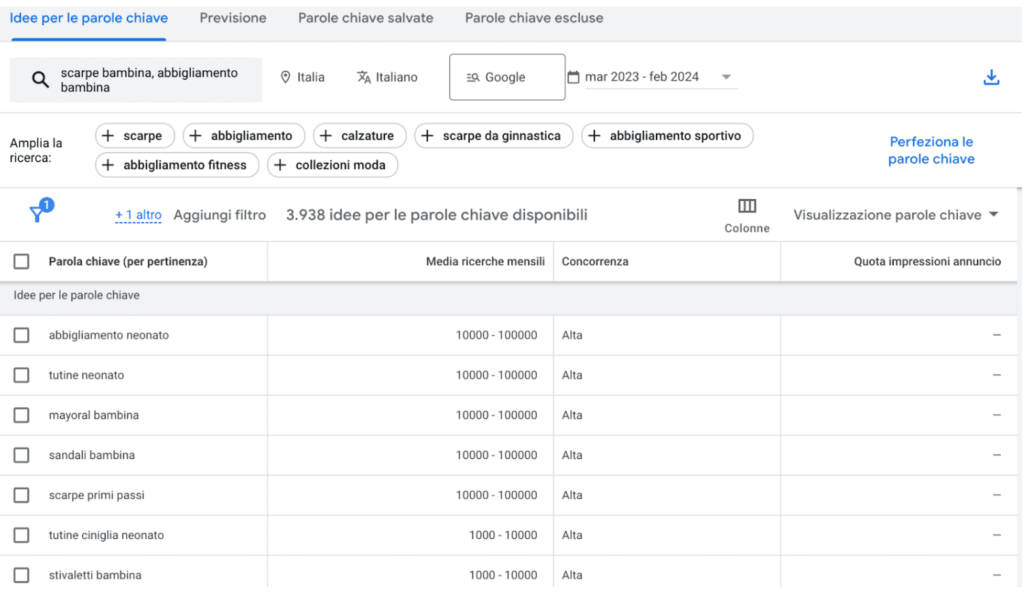
In the example, you can see the Keyword Planner screen suggesting relevant keywords related to "girls' shoes" and "girls' clothing".
On-Page SEO: Creating Original, Valuable Content
Creating high-quality content, meaning content that is relevant to your users, is essential for ranking success.
Google rewards sites that offer value through informative, relevant text, and it still favors human-written content despite the rise of generative AI.
What exactly do we mean by "quality content"? Well-organized text with consistent keywords, not randomly placed ones, and accurate information delivered in an engaging way. This increases time on site and lowers the bounce rate: a metric showing the percentage of visitors who leave your website after viewing only one page, without interacting further.
Your copy also must not contain duplicate parts: this is one of the most common causes of penalties from Google.
If you have an e-commerce site, take care to write original descriptions for your products rather than copying them from other platforms.
Off-Page SEO: Backlinks
Off-Page SEO refers to all the activities outside your website, such as link building and social media presence, aimed at improving your site's ranking in search engine results.
The role of backlinks
In search engine ranking strategy, link building plays a key role. This activity focuses on earning high-quality backlinks from authoritative sites relevant to your industry.
In other words, it won't do you much good if your site sells awnings and gets a link from a cosmetics site, even an authoritative one.
An effective link building approach therefore aims to earn relevant backlinks and carefully monitor the associated anchor text, which must stay consistent with the context it appears in.
Social Media Marketing and SEO Rankings
Social media has an indirect but still very important impact on SEO. Activities like sharing your site's content and engaging with your audience can increase your platform's visibility and relevance, which in turn influences its ranking.
Even though engagement signals like likes and shares aren't directly tied to ranking, search engines can read them as signs of your site's authority and popularity, helping to boost its traffic and visibility.
An active social media presence can therefore generate more engagement, communicate your brand's character and earn you good backlinks naturally.
All of this helps improve your overall SEO.
A Little Help with SEO in 2024: The 3 Best Tools to Use
Monitoring and analytics tools like Google Analytics and Google Search Console are essential to optimize your SEO strategy, track it constantly and adapt it over time.
These tools give you detailed, real-time insights into how your website performs in search engines and how users experience it.
For deeper keyword and competitor analysis, you can rely on specialized tools like Semrush, SEOZoom and Ahrefs, which are used by many web agencies in Milan.
Semrush
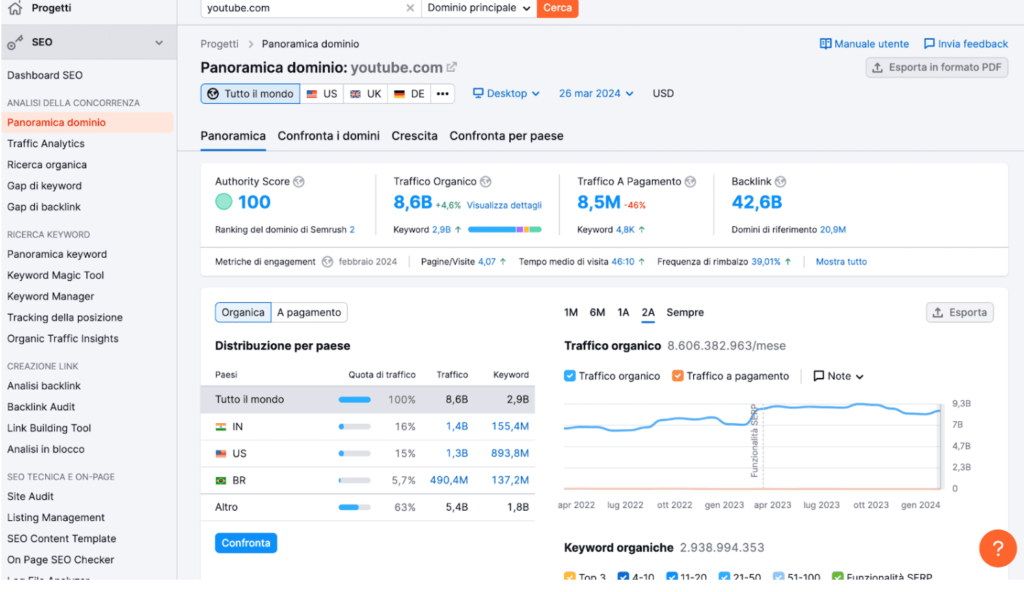
offers a wide range of features, including research on the most relevant keywords for your industry and analysis of your competitors' strategies.
The platform lets you run in-depth keyword research with tools like the Keyword Magic Tool and the Keyword Manager, making it easier to find and organize the keywords that fit your target audience. It also offers a vast backlink database and tools to manage your link building strategy.
It also supports technical SEO, helping you spot and fix issues with the Site Audit tool and improve the visibility of individual pages with the On-Page SEO Checker. For businesses focused on local visibility, Semrush offers tools to manage listings and reviews and to track local keyword rankings. It also includes market analysis features and keyword research tailored to ads, to optimize their conversions.
Ahrefs
is a powerful online marketing tool with a range of features to boost a website's online visibility.
Among its key features, it stands out for assessing the quality and quantity of backlinks pointing to a site, and for comparing them with those of its direct competitors.
Beyond these features, Ahrefs offers tools for content analysis, for identifying relevant influencers and websites so you can build a digital PR strategy, and for analyzing your competitors' SEO strategies to uncover opportunities for improvement.
It also lets you monitor mentions of your site and brand online, find new content ideas, and get detailed data on website traffic and social media performance.
SEOZoom
SEOZoom is an all-Italian platform that offers a wide range of features to improve the performance and visibility of websites on search engines. Its tools include in-depth keyword analysis, competitor monitoring, site audits, backlink analysis and much more.
SEOZoom is designed for industry professionals, marketing agencies and website owners who want to grow their web presence and get measurable results as quickly as possible. The platform stands out for its accurate, up-to-date data, which helps users make informed decisions and build effective strategies to improve their search engine rankings.
The interface is clear and intuitive, which makes SEOZoom a great tool even for SEO beginners.
In our complete 2024 SEO guide, we've covered every crucial aspect to consider, highlighting how Search Engine Optimization keeps evolving. As we said at the start, developments like the arrival of generative AI in search engines will require constant refinement of your strategies and careful analysis of every aspect mentioned.
To do this the right way and keep your site visible in 2024, consider working with a reliable, skilled partner to save time and money. SHM Studio, a web agency in Milan with years of experience, can give you the support you're looking for. With a team of highly qualified experts, we deliver tailored solutions that meet each client's specific needs, with tangible, lasting results. If you have questions about this guide, or you'd like a free consultation to improve your website's visibility and optimize your SEO strategy in 2024, don't hesitate to contact us today. We're here to help you reach your online goals.
Related articles
Discover more articles exploring similar topics, selected to offer you a more complete and stimulating perspective. Each piece of content is carefully chosen to enrich your experience.