

- Is it really worth paying attention to artificial intelligence companies, or is it still too early for my business?
- How many Italian businesses already use AI? The data you need to know
- How is work changing with the rise of artificial intelligence companies?
- Which industries are changing the most thanks to artificial intelligence?
- How does AI work in manufacturing: what changes on the factory floor?
- What changes in finance, healthcare and marketing with artificial intelligence?
- Finance: faster data and decisions
- Healthcare: earlier diagnoses
- Marketing and sales: personalization at scale
- How are logistics and transportation changing with AI?
- Remote work and AI: what concrete opportunities for your company?
- Three real-world scenarios: how does the picture change for different Italian companies?
- What risks and rules should you know before adopting AI in your company?
- How do you get started: concrete steps to adopt AI in your company
- What mistakes are most common when adopting AI in a company?
- How do I know if AI is really working in my company?
- So, is adopting AI worth it for your company?
- How we see it at SHM
- Frequently Asked Questions
- Artificial intelligence companies are redefining manufacturing, finance, healthcare, marketing and logistics: this is not a future trend, it's already happening.
- In Italy, AI adoption among businesses has tripled in two years (from 5% to 16.4%), but SMEs are lagging behind: 76% haven't invested yet.
- AI doesn't eliminate jobs, it transforms them: new roles are emerging, and companies that train their people now gain a competitive edge.
- Getting started doesn't require a big budget: begin with one repetitive process, measure the result and scale gradually.
Updated November 19, 2026
In Italy, only 19% of businesses use AI — just below the EU average of 20% — while 76% of SMEs haven't yet invested a single euro in it. The gap widens with every passing month.
Is it really worth paying attention to artificial intelligence companies, or is it still too early for my business?
It's not too early: Italian data shows rapid acceleration, and those who wait risk falling behind competitors that have already automated their key processes.
The question we hear most often from business owners and managers is this: "Does this really apply to me, or is it just for big tech companies?" The answer is uncomfortable: it applies to everyone, and sooner than you think.
Artificial intelligence companies — that is, businesses that develop or adopt AI technologies in their own processes — are no longer an exclusive club of multinationals. They are manufacturers, professional firms, retail chains, mid-sized e-commerce businesses. The adoption of AI solutions is already having a deep impact on production processes in sectors that seemed immune to automation just three years ago.
| Your situation | Should you adopt AI? | why |
|---|---|---|
| You have repetitive processes (invoicing, order management, customer support) | Yes | Automation reduces errors and frees up your team's time |
| You have data but can't read it in a useful way | Yes | AI turns raw data into concrete decisions |
| You're in a competitive industry with tight margins | Yes | Operational efficiency becomes a cost advantage |
| You have fewer than 10 employees and no structured processes | A middle ground | Better to structure your processes first, then automate them |
| You have no budget or time to train your team | No, for now | Without internal adoption, the tools go unused |
How many Italian businesses already use AI? The data you need to know
In Italy, the share of businesses with at least 10 employees using AI has tripled in two years, but we're still below the European average and far behind the Nordic countries.
The numbers speak for themselves. According to Istat, "Imprese e ICT – Anno 2025", the share of Italian businesses with at least 10 employees using at least one artificial intelligence technology rose from 5% in 2023 to 8.2% in 2024, and up to 16.4% in 2025. Rapid growth, but one that hides a significant gap: among large companies the share reaches 53.1%, while SMEs remain far behind.
At the European level, according to Eurostat, in 2025 20% of EU businesses with at least 10 employees used AI technologies — up 6.5 points from 13.5% in 2024. Italy stands at 19%, just under the average.
The most worrying finding comes from the Osservatorio Innovazione Digitale nelle PMI at Politecnico di Milano: 76% of Italian SMEs have not invested and don't plan to invest in AI, and only 7% have launched structured training programs. Over time, that delay turns into a real competitive disadvantage.
How is work changing with the rise of artificial intelligence companies?
AI doesn't eliminate work: it transforms it. The most repetitive tasks disappear, and new roles emerge that require digital skills and the ability to work with data.
The most widespread fear is replacement. According to Pew Research, in 2026 71% of American adults believe AI will lead to fewer jobs over the next twenty years — up from 64% in 2024. Only 5% think it will create more. The perception is clear, but reality is more nuanced.
Automation hits repetitive, low-value tasks: data entry, routine email management, standard reporting, visual quality control. In their place, new roles emerge: data scientists (who analyze and interpret data), machine learning experts (who train AI models), predictive maintenance technicians and cybersecurity specialists. Staff training is already underway in the most advanced companies.
According to Pew Research Center, in 2025 21% of US workers say they use AI for at least part of their job, up from 16% in 2024. 65% say they hardly use it at all. The change is real but gradual — and those who train now get a head start.
One often underestimated aspect is hybrid and remote work. AI platforms make remote collaboration easier, streamline workflows and cut administrative tasks. Employees can focus on more strategic and creative work while AI handles the routine. The challenges remain: cybersecurity, privacy management, ongoing training. But companies that tackle these challenges now build a lasting competitive advantage. To learn how to manage internal adoption without resistance, it's worth reading the guide on AI change management in the company.
Which industries are changing the most thanks to artificial intelligence?
Manufacturing, finance, healthcare, marketing and logistics are the sectors with the greatest impact already visible. Each area has specific applications and measurable results.
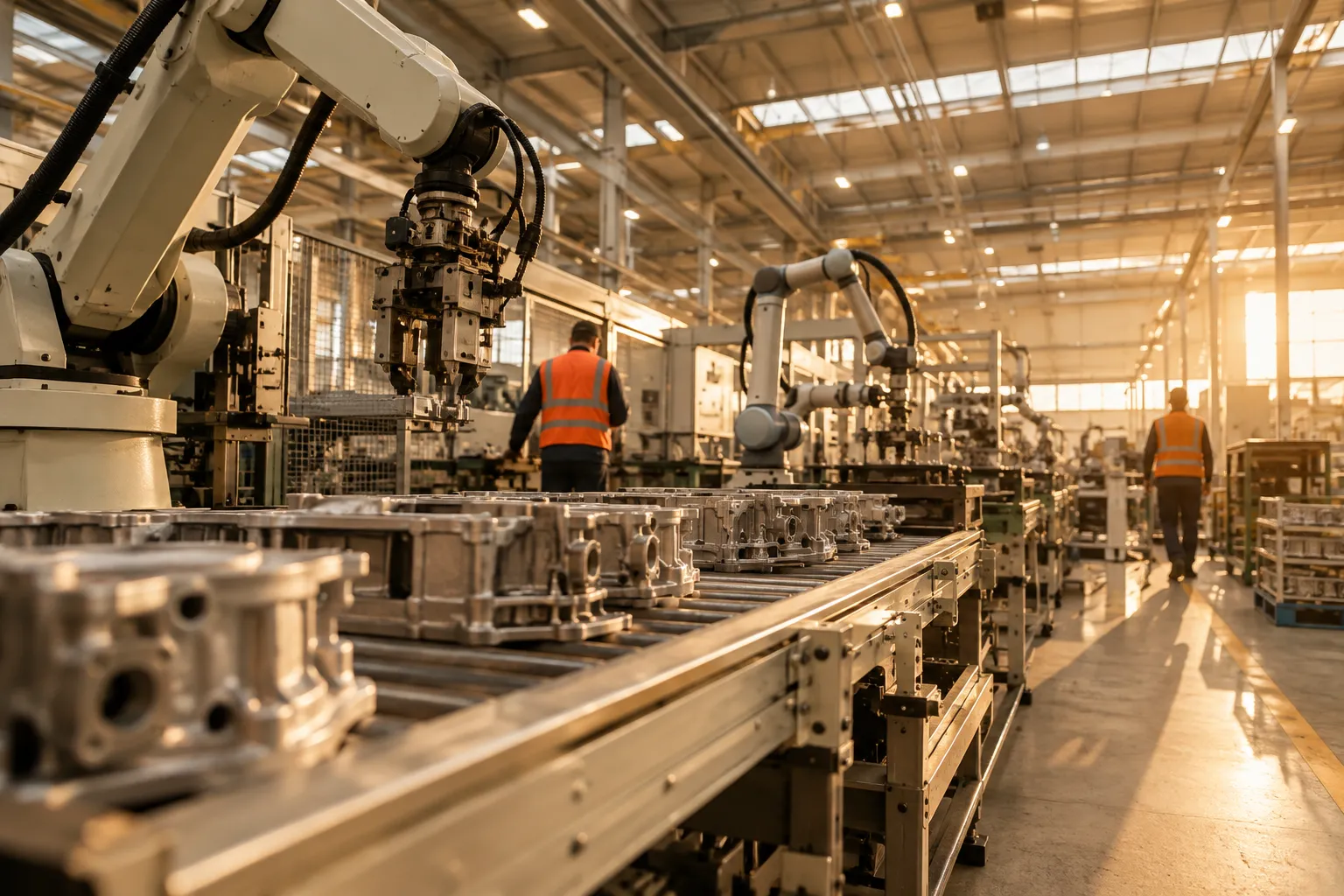
AI applications cut across every field: from SEO for websites to automated marketing, from medical diagnostics to predictive warehouse management. Let's look at the sectors with the greatest concrete impact.
| sector | Main use | Concrete benefit | Example companies |
|---|---|---|---|
| Manufacturing | Predictive maintenance, collaborative robots (cobots) | Less machine downtime, fewer human errors | Siemens, General Electric |
| finance | Fraud detection, algorithmic trading, robo-advisory | Faster decisions, reduced risk | European banks and fintechs |
| Healthcare | Medical image analysis, personalized medicine | Earlier diagnoses, targeted therapies | Google Health, IBM Watson |
| Marketing and sales | Personalization, chatbots, recommendations | More conversions, 24/7 support | Amazon, Netflix |
| Transportation and logistics | Route optimization, warehouse management | Lower costs, faster deliveries | Tesla, Waymo |
How does AI work in manufacturing: what changes on the factory floor?
In manufacturing, AI makes it possible to predict failures before they happen, optimize production in real time and reduce waste thanks to interconnected factories.
Manufacturing is among the first sectors to have integrated AI solutions into its processes. Predictive maintenance — the ability to predict when a machine will fail before it actually stops — reduces downtime and lowers maintenance costs. Collaborative robots, known as cobots, work side by side with human operators, increasing precision and improving workplace safety.
Smart factories go further: machines are interconnected and communicate with each other to optimize the entire production process. Technologies like the Digital Twin — a digital replica of a physical plant that lets you simulate scenarios without stopping production — and the Industrial Internet of Things (the network of connected sensors and devices on the factory floor) are accelerating this transition. The result: less waste, more sustainability, safer operators.
Companies like Siemens and General Electric have already adopted smart manufacturing strategies that include predictive quality control and dynamic plant management. For an Italian manufacturing SME, the most accessible starting point is often predictive maintenance on one or two critical machines.
What changes in finance, healthcare and marketing with artificial intelligence?
In finance, AI detects fraud in real time and personalizes advice; in healthcare it enables earlier diagnoses; in marketing it turns every customer interaction into a tailored experience.
Finance: faster data and decisions
The financial sector grasped AI's potential right away. Analyzing amounts of data that were unthinkable just a few years ago makes it possible to identify anomalies, predict market fluctuations and detect fraud attempts in real time. Robo-advisory platforms — automated investment advice systems — offer personalized suggestions based on data analysis and machine learning, making quality advice accessible even to investors with moderate assets.
Healthcare: earlier diagnoses
In healthcare, systems like Google Health and IBM Watson analyze medical images and identify diseases at an early stage with greater accuracy than traditional methods. Personalized medicine goes further: AI algorithms analyze a patient's genetic profile and suggest targeted therapies, reducing side effects and making treatments more effective. AI also optimizes the management of hospital facilities, improving operational efficiency.
Marketing and sales: personalization at scale
The sales sector has embraced AI to deliver increasingly personalized shopping experiences. Thanks to data processing, companies predict customer preferences, optimize inventory and improve logistics efficiency. Chatbots and virtual assistants have already changed customer support, offering instant 24/7 assistance. E-commerce platforms like Amazon use advanced recommendation algorithms to suggest targeted products based on users' buying habits. To dive deeper into AI strategies in marketing, the guide on AI marketing and artificial intelligence in business strategy is a great starting point.
How are logistics and transportation changing with AI?
In logistics, AI optimizes routes, manages warehouses predictively and cuts operating costs: real benefits for SMEs with a distribution network, too.
AI has a major impact on transport and logistics too. From smart traffic management to optimized route planning, companies use advanced algorithms to cut delivery times and minimize operating costs. Self-driving vehicles, tested by companies like Tesla and Waymo, are a step toward fully automated mobility, even if large-scale adoption is still in its early stages.
For Italian SMEs, the most immediate application is predictive warehouse management: algorithms that analyze historical order data and optimize the flow of goods, reducing storage times and picking errors (the physical collection of products to be shipped). An e-commerce business with a mid-sized warehouse can significantly cut operating costs with tools already available on the market.
Remote work and AI: what concrete opportunities for your company?
AI makes remote work more efficient, secure and measurable: it automates routine tasks, improves communication across distributed teams and protects company data.

Smart working is no longer an emergency measure: it's a stable way of working for many Italian companies. AI plays a crucial role in this shift, making resource management more efficient and coordination of distributed teams more effective.
- 1 · Routine automationFewer low-value tasksEmail management, reporting, data entry: AI handles them on its own, freeing up time for strategic work.
- 2 · Communication and collaborationTeams connected anywherePlatforms like Microsoft Teams and Slack use AI algorithms to optimize project management and track deadlines.
- 3 · Data securityProactive protectionAI cybersecurity software spots unusual behavior and prevents breaches before they happen.
- 4 · Personalized workTailored workflowsAlgorithms analyze employees' work habits and suggest tools or methods to boost productivity.
- 5 · Ongoing trainingThe critical bottleneckWithout targeted training, AI tools go unused. Only 7% of Italian SMEs have launched structured programs.
One of the main obstacles to smart working remains secure management of company data. Artificial intelligence companies offer advanced solutions to protect sensitive information, spot unauthorized access attempts and monitor potential vulnerabilities in digital systems. Through predictive analysis, cybersecurity software detects unusual behavior and prevents breaches before they happen. To dig deeper into data protection from an AI perspective, the guide on privacy and artificial intelligence for SMEs offers practical, up-to-date advice.
Companies that balance innovation and security will turn remote work into a real competitive advantage. The topic is also covered in our analysis of what your company gets wrong with AI and how to fix it.
Three real-world scenarios: how does the picture change for different Italian companies?
The value of AI varies widely depending on industry and company size. Here are three illustrative examples to show where the real benefits are concentrated.
Illustrative examples: numbers are meant to show the reasoning, they are not real customer data.
| Company type | Automated process | Estimated benefit | Typical tool |
|---|---|---|---|
| E-commerce with 5,000 orders/month | Customer support via chatbot (refunds, tracking) | 60% fewer tickets handled by human agents | AI chatbot on WhatsApp or your website |
| Professional firm (accountant, 3 partners) | Extraction and classification of tax documents | 8-10 hours/week saved per employee | OCR + AI software for documents |
| Manufacturing company (50 employees) | Predictive maintenance on 3 critical machines | 30% fewer unplanned downtimes | IIoT sensors + predictive platform |
In all three cases, the starting point is the same: identify the most repetitive and costly process, measure the time it takes today, and assess which AI tool can handle it on its own. You don't need to start with a project worth hundreds of thousands of euros. For an overview of the tools available, the guide AI for SMEs: the 15 most useful tools in 2026 is a practical, up-to-date reference.
What risks and rules should you know before adopting AI in your company?
There are three main risks: data security, regulatory compliance and vendor dependency. Knowing them in advance helps you avoid costly problems.
Adopting AI without a strategy exposes your company to real risks. The first is data security: AI systems process large amounts of sensitive information, such as customer data, financial data and trade secrets. An inadequate IT infrastructure is a point of vulnerability. The second risk is regulatory compliance: the European AI Regulation (AI Act) is now in force and sets different obligations depending on an application's risk level. The third is vendor dependency: relying on a single provider with no exit strategy can become a problem if prices change or the service goes down. On this topic, our analysis of open source AI and on-premise models offers a useful perspective for those who want to stay in control.
According to the Intelligent Business Process Automation Observatory at Politecnico di Milano, only 9% of Italian SMEs use robotic process automation (RPA) solutions, and in fewer than 1% of cases have AI pilots for automation been launched. Among those who don't use AI in automation today, though, 45% plan to introduce it within the next 12 months: change is imminent.
| Risk | Potential impact | How to mitigate |
|---|---|---|
| Data breach | GDPR fines, reputational damage | Encryption, limited access, regular audits |
| AI Act non-compliance | System shutdown, fines | Classify the application's risk level before adopting it |
| Dependence on a single vendor | Unexpected costs, service interruptions | Evaluate open source or multi-vendor alternatives |
| Internal resistance from staff | Failed adoption, wasted budget | Training and involvement before launch |
| Poor-quality training data | Unreliable AI results | Clean and structure your data before automating |
For those running AI systems with autonomous agents, meaning software that makes decisions independently, security and compliance risks are even more specific. Our analysis of autonomous AI models and risks for businesses explores this scenario with practical guidance.
How do you get started: what are the concrete steps to adopt AI in your company?
Start with a process, not a platform: identify the most costly routine, choose the right tool, train your people and measure results before scaling.
- 1 · Step 1Map your repetitive processesList the tasks your team repeats every week. Calculate the total time. These are the first candidates for automation.
- 2 · Step 2Choose a pilot processDon't automate everything at once. Pick a low-risk, high-volume process: customer support, email classification, reporting.
- 3 · Step 3Evaluate the available toolsCompare ready-made solutions (SaaS) with custom development. For SMEs, SaaS tools are often enough and faster to adopt.
- 4 · Step 4Train your staff before launchInvolve the team in the testing phase. Those who use the tool every day need to understand its logic, not just the buttons.
- 5 · Step 5Measure results after 30-60 daysDefine your KPIs (performance indicators) first: time saved, fewer errors, lower costs. Without measurement, you can't tell if it works.
- 6 · Step 6Scale graduallyIf the pilot works, extend it to other processes. If it doesn't, fix it before investing more.
What mistakes are most common when adopting AI in a company?
The most common mistakes are starting from the technology instead of the problem, not training your people and not measuring results. All three can be avoided.
| Common mistake | Why it is a problem | How to avoid it |
|---|---|---|
| Choosing the tool before understanding the problem | Buying technology you don't need | Map the process first, then look for the tool |
| Not involving staff | The team sabotages or ignores the tool | Shared training and testing before launch |
| Expecting immediate results | Giving up too early | Real benefits come after 60-90 days of use |
| Not defining KPIs before starting | You can't tell whether it works or not | Set success metrics before launch |
| Relying on a single vendor with no alternative | Dependence and unexpected costs | Always evaluate at least two options and read the contracts |
| Neglecting data security | GDPR violations and reputational damage | Involve your IT manager or a consultant before you start |
How do I know if AI is really working in my company?
Measure three things: time saved, output quality and cost per unit of process. If all three improve, AI is working.
| Indicator | How it is measured | Positive signal |
|---|---|---|
| Time saved per process | Hours/week before vs. after adoption | At least a 20% reduction in the first 8 weeks |
| Error rate | Errors per 100 operations before vs. after | Visible reduction within the first month |
| Staff satisfaction | Quarterly internal survey | The team feels fewer repetitive tasks |
| Cost per process unit | Total cost divided by number of operations | Gradual reduction over time |
| Customer response time | Average minutes/hours per response | Measurable reduction if you use a chatbot or automation |
| Actual tool adoption | % of the team using the tool every day | At least 70% adoption after 60 days |
If you want to learn how to measure the return on AI investment before you even spend, the analysis on AI ROI in business: how to measure it before you spend offers a practical framework that works even without a dedicated IT department.
So, is adopting AI worth it for your company?
Worth it if you have high-volume repetitive processes, data to analyze or a customer service operation to scale. AI reduces operating costs and frees your people for higher-value work.
Somewhere in between: you're in a growth phase but don't have structured processes yet. First define how you work, then automate: AI amplifies what works, it doesn't fix disorder.
Not yet if you have no budget for staff training or can't dedicate time to testing and measuring. Adoption without internal ownership delivers poor results and wastes resources.
How we see it at SHM
For us, AI is the means, not the end. We believe technology should free companies from routine, giving people back time to do what only they can do, and not become an end in itself. This is the principle that guides every project we work on.
At SHM Studio we work with SMEs and mid-sized companies that want to adopt AI in a concrete, measurable way. Among others, we worked with a manufacturer and distributor with over 4,000 SKUs in 20 markets: the problem was a digital catalog out of sync with the ERP, with different data for each country. We built an automatic daily synchronization engine that generates complete, multilingual product sheets automatically. The result is a single, always up-to-date catalog for four markets. It wasn't a lab project: it was a real problem, solved with AI tools integrated into existing processes.
If you're weighing where and how to start, our services for strategic integration of AI into business processes, data processing and business intelligence and AI-driven SEO techniques are built for companies that want concrete results, not experiments. You can also request a consultation to find out where to start in your specific case.
AI adoption in Italian companies is at the heart of our editorial work: you'll find all our in-depth articles in the section dedicated to AI and process automation.
Frequently Asked Questions
"Artificial intelligence companies" can mean both businesses that develop AI technologies (such as machine learning software or predictive systems) and those that adopt them in their own processes to boost efficiency. Today the second group is much larger than the first and includes SMEs in every industry.
AI automates repetitive, low-value tasks, not entire jobs. New roles are emerging around data management, supervision of automated systems and cybersecurity. Companies that invest in staff training turn AI into an advantage, not a threat.
The most effective starting point is to identify the most repetitive and time-consuming process: customer support, document classification, reporting. You pick a tool already available on the market, train your people and measure results after 30-60 days before expanding adoption.
There are three main risks: data security (AI systems process sensitive information and need adequate infrastructure), regulatory compliance (the European AI Act sets obligations based on an application's risk level) and dependency on a single vendor. All three can be managed with careful upfront planning.
Costs vary enormously: from a few euros a month for ready-made SaaS tools (chatbots, document automation software) to tens of thousands of euros for custom development. For most SMEs, the most efficient approach is to start with existing SaaS tools and consider custom development only after validating the process.
Define your KPIs before you start: time saved per process, error rate, cost per operation, staff satisfaction. Measure these indicators before and after adoption. If all of them improve within the first 8 weeks, AI is working. If they don’t, the problem is often data quality or staff training.
AI is not a shortcut: it's a multiplier — and it only works if there's something solid to multiply.
Related articles
Discover more articles exploring similar topics, selected to offer you a more complete and stimulating perspective. Each piece of content is carefully chosen to enrich your experience.



















































