

- 1. Understanding the new context for positioning a website
- 2. Why SEO is still decisive in 2026
- 3. Core Web Vitals: performance as a prerequisite
- Practical interventions
- 4. Technical SEO: structure, crawling and indexing
- 5. On-page SEO: content oriented to search intent.
- On-page best practices
- 6. Keyword research: choosing the right words with the right tools
- Semrush
- Ahrefs
- SEOZoom
- 7. Advanced SEO AI tools: Botify, Frase, SurferSEO.
- 8. User experience: user behavior matters
- 9. Local and off-page SEO: positioning a website in its ecosystem
- Local SEO:
- Off-page SEO:
- 10. Where to start when positioning a website in 2026
- 11. Bonus: mistakes to avoid if you want to position a website
- A (very concrete) invitation to confrontation
- The most interesting FAQs for correctly positioning on the website on search engines
To rank a website in 2026, it is no longer enough to publish content and enter keywords: an integrated approach is needed that combines technical SEO, performance, useful content, UX, external authority, and AI tools. The new search engine environment is also dominated by AI boxes and Search Generative Experience, so the site must be easily readable by both users and generative search systems. The article stresses the importance of starting with Core Web Vitals, proper technical structure, clean indexing, content built on search intent and keyword research done with professional tools such as Semrush, Ahrefs and SEOZoom. Added to this is the use of advanced AI tools such as Botify, Frase and SurferSEO for analysis and content production support. User experience, local SEO, quality link building, and constant data monitoring also matter a lot. The central message is that SEO positioning today is systemic and continuous work: technique, content, reputation and artificial intelligence must work together. SHM Studio acts as a partner to help companies and professionals transform the site into a concrete and measurable business asset.
Positioning a website in 2026 requires a solid technical foundation, quality content, a great user experience, and the intelligent use of SEO and AI tools. This checklist, created by us at SHM Studio, a web agency specializing in SEO and AI marketing, summarizes the essential steps to understand where to take action and what priorities to follow.
1. Understanding the new context for positioning a website
In 2026, positioning a website means competing in a SERP (the page where search results are shown) where they coexist:
- Organic “classic” results.
- AI box (Search Generative Experience, SGE) with summary answers at the top of the page.
- Multimedia elements and increasingly rich results.
In addition, today Google uses the’artificial intelligence to provide answers directly in SERPs, reducing traffic to traditional links. Consequently, to stand out, it is critical that the site must become a trusted source for AI responses.
This requires structured content, clear data, signals of authority, and a technical basis that makes the site easily interpretable by generative search systems.
2. Why SEO is still decisive in 2026
Despite the recent implementation of AI in search engines such as Google, if you want your digital project to grow you still need to place your website in the right searches. To do this, you need to import a structured and careful strategy that allows you to:
- Intercept qualified organic traffic, less dependent on paid campaigns.
- Strengthen brand visibility and credibility over time.
- Improve conversions, leads and sales for the same marketing budget.
Failure to meet the parameters imposed by SEO means having a site that technically works, but actually remains invisible when users search for products or services like yours.
3. Core Web Vitals: performance as a prerequisite
In order to position a website in 2026, enormous attention must be paid to the Core Web Vitals, which Google considers direct ranking signals. Some of these indicators are:
- LCP (Largest Contentful Paint): the loading time of the main content.
- CLS (Cumulative Layout Shift): measures the “jump” of the layout during loading.
- INP (Interaction to Next Paint): the overall responsiveness of the page to interactions, a metric that replaced FID.
These values must remain within a certain tolerance to be considered positively by search engines, otherwise the site may find it difficult to rank even in the presence of good content and quality links.
Practical interventions
To improve these values and thus contribute to page indexing, some basic actions can be taken:
- Reduce the weight of images and videos (compression, WebP/AVIF formats).
- Limit blocking scripts and CSS, use lazy loading for non-critical elements.
- Implement server-side caching, CDN, and HTTP/2 or HTTP/3 protocols.
- Monitor periodically with PageSpeed Insights and Core Web Vitals reports.
Given their importance, our SEO analysis techniques in SHM Studio, verification of Core Web Vitals is one of the first steps in creating favorable conditions for placement.
4. Technical SEO: structure, crawling and indexing
Technical SEO is the invisible basis for search engines to examine and interpret the site. It consists of all those technical actions aimed at ensuring proper reading of the site by Google and the like. Metadata, indexes, files, and URLs must all meet certain conditions. To rank a website stably, for example, it is essential:
- Design clean and readable URLs consistent with the content hierarchy.
- Configure the robots.txt file correctly, without blocking essential resources.
- Maintain an updated XML Sitemap and submit it to Google Search Console.
- Manage canonical and 301 redirects to avoid duplication and cannibalization.
- Use HTTPS everywhere, with consistent redirects from HTTP to HTTPS.
An SEO analysis, even carried out using artificial intelligence tools, helps unearth errors that would otherwise remain obscure, such as orphan pages, redirect loops and duplicate content.
5. On-page SEO: content oriented to search intent.
To position a website in 2026, on-page SEO must revolve around users' real intent, their specific questions and curiosities:
- Informational intent (“how to position a website”).
- Commercial intent (“SEO agency for SMEs”).
- Navigational intent (“shm studio”).
- Local intent (“web agency Milan center”).
On-page best practices
A few simple actions can be taken to improve on-page SEO:
- Associate each page with a specific search intent.
- Insert the main keyword - in this case positioning a website - naturally in title, H1, introduction and some strategic sections.
- Structure text with clear H2s, H3s, short paragraphs, lists and example blocks.
- Optimize the meta title and meta description for the click, while maintaining consistency with the content.
- Curate images (filename, alt text) and, when appropriate, schema markup (Article, FAQ, Product, LocalBusiness).
As a Milan-based Web Agency specializing in SEO, we at SHM Studio work on just that: bringing content into alignment with search intentions and algorithm expectations.
6. Keyword research: choosing the right words with the right tools
Without good keyword research, it is not possible to properly position a website, even by making use of the most modern tools and assistants. Although other factors have taken over, keywords remain one of the foundations of SEO even in 2026. This is where the professional tools we use every day come into play.
With the constant evolution of search engine algorithms, it is essential to use effective tools to simplify the process of ranking a website. We at SHM Studio would like to present a selection of indispensable tools to improve SEO. In addition, we will analyze their features and benefits.
These tools provide detailed, real-time information about your website's search engine performance and user experience, from keyword research to competitive analysis.
Semrush

It offers a wide range of features, including searching for the most relevant keywords for your industry and analyzing the strategies adopted by your competitors.
La platform allows you to conduct in-depth keyword research using tools such as the Keyword Magic Tool and Keyword Manager, making it easier to identify and organize those relevant to your target audience. It also offers an extensive backlink database and tools to manage your link building strategy.
It also provides technical SEO support, helping to identify and resolve issues through the Site Audit tool and improve individual page visibility with the On-Page SEO Checker. For businesses interested in local visibility, Semrush offers tools for managing listings, reviews, and monitoring local keyword positions. There are also features for market analysis and specific keyword research for advertisements to optimize their conversions.
Ahrefs

It is a powerful online marketing tool that offers several features to improve the online visibility of a website.
Prominent among its main features is the evaluation of the quality and quantity of backlinks pointing to the site. Besides that, it offers comparison of the latter with those of direct competitors.
In addition to these features, Ahrefs offers provides tools for content analysis, for identifying relevant influencers and websites in order to develop a digital public relations strategy, and for analyzing competitors' SEO strategies to identify opportunities for improvement.
It then allows you to monitor mentions of your site and brand online, identify new content ideas, and obtain detailed data on website traffic and social media performance.
SEOZoom
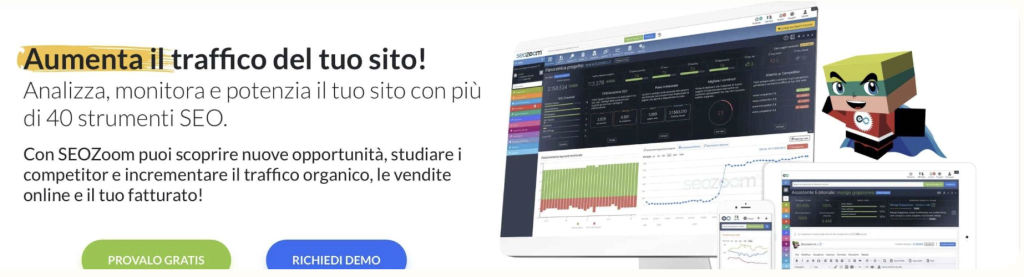
SEOZoom is an all-Italian platform that offers a wide range of features to improve the performance and visibility of websites on search engines. These tools include in-depth keyword analysis, competition monitoring, site audits, backlink analysis, and more.
SEOZoom is aimed at professionals, marketing agencies and website owners who want to boost their online business by achieving measurable results in the shortest possible time. The platform is distinguished by its ability to provide accurate and up-to-date data, enabling users to make informed decisions and develop effective strategies to improve search engine rankings.
The interface is particularly straightforward and intuitive, making SEOZoom a great tool even for those new to SEO.
7. Advanced SEO AI tools: Botify, Frase, SurferSEO.
In addition to “classic” tools, it is very useful in 2026 to integrate AI tools to speed up analysis and content creation. In the original post we mentioned three tools in particular, which we take up and integrate here in the checklist.
1. Botify

Do you want to be in total control of all aspects of your site's SEO? Then Botify Is the SEO AI Tool for you. With this tool, you can analyze the technical and content performance of your website. In addition, you can track the behavior of search bots and user interactions.
The tools that Botify makes available are many: one of the most useful is the ability to monitor the SEO performance of competitors, highlighting their strengths but also their weaknesses, content discovered, and the keywords used.
With the help of artificial intelligence, this tool is perfect for quickly highlighting and solving any website problems that limit its indexing and visibility.
2. Phrase

Do you go strong in your business but lack the aptitude for writing and fail to create punchy copy and articles that truly reflect your company? Phrase then it's the tool you've been looking for.
Frase is an excellent SEO AI Tool for content creation that harnesses the power of built-in artificial intelligence to generate SEO-friendly articles without sacrificing readability.
In addition, the software is able to suggest possible topics and relevant topics. All this in addition to SEO-optimizing your previous work.
3. SurferSEO
SurferSEO is an incredible tool that integrates artificial intelligence with a kit of software that will allow you to make your website enjoyable and with a truly user-friendly experience, without sacrificing SEO and readability.
One of the main tools is Surfer AI, which calls itself a “traffic generator, not a content generator.” In just a few clicks you can create an article from scratch, providing only the trend keyword to be developed. Thanks to the power of AI, you can also discover dozens of keywords related to your topic. Writer's block, goodbye!
SurferSEO is an SEO AI tool that can also be integrated with common digital marketing tools, as WordPress e Google Docs. In addition to this, it provides an anti-plagiarism function and offers innovative business solutions.
8. User experience: user behavior matters
Google observes, obviously in aggregate, how long users stay on the site, how they interact, and whether they return or abandon quickly. Good UX helps rank a website because it sends positive signals of customer satisfaction, ranking the page as dilated level and authoritative.
UX elements to be taken care of most include:
- Mobile-first design with intuitive menus and easy-to-use buttons.
- Readable, coherent, well-formatted text with adequate white space.
- Clear navigation, breadcrumbs, internal links that guide the user to related content.
- Reduction of invasive pop-ups and interruptions that ruin the experience.
A user who moves easily, reads, scrolls, and interacts is a user who “tells” the search engines that that site deserves to be at the top.
9. Local and off-page SEO: positioning a website in its ecosystem
Some businesses that are more locally related might aim to position their website in a certain geographic area or in a specific sector. For this very purpose there is local SEO, which helps businesses to be more visible in a certain area.
Local SEO:
- Optimize Google Business Profile with relevant categories, clear descriptions, updated photos, schedules and posts.
- Maintain consistent NAP (Name, Address, Phone) on site, directories and local portals.
- Stimulate authentic reviews and respond with care.
- Create local pages with real content by city, province or area served.
Off-page SEO:
The authority of the website helps to place it higher in the SERP. Being considered, named, and recognized by other sites, entities, or customers positively influences SEO.
- Build quality backlinks with guest posts, collaborations, digital PR.
- Get brand mentions on blogs, podcasts, social media, and industry portals.
- Post content worth linking to (guides, studies, useful resources).
In SHM Studio we prefer long-term strategies, sustainable and in line with Google's guidelines, avoiding shortcuts that can lead to penalties.
10. Where to start when positioning a website in 2026
In summary, to position a website in 2026, the steps to follow are:
- Understanding the new scenario dominated by AI and SGE.
- Getting Performance and Core Web Vitals in Order.
- Fix technical SEO so that the site can be easily crawled and indexed.
- Designing on-page content around research intent.
- Use professional tools (Semrush, Ahrefs, SEOZoom) for data-driven decisions.
- Integrate advanced AI tools (Botify, Frase, SurferSEO) for analysis and content.
- Nurturing UX, local SEO, and off-page authority.
11. Bonus: mistakes to avoid if you want to position a website
As an “extra point” in the checklist, here are some mistakes we often see in projects that come to us that make it more difficult to place a website stably:
- Keyword stuffing: excessive repetition of the keyword, with unnatural and unreadable text.
- AI-only generated content without human review: risk being inaccurate, repetitive, or not aligned with useful content guidelines.
- Ignore Core Web Vitals and mobile-first: a slow or difficult-to-use site on smartphones starts at a disadvantage.
- “Quick” link building from poor networks: may bring temporary benefits, but in the medium term exposes to penalties.
- Don't measure anything: working without data (Search Console, Analytics, SEO tools) makes it impossible to figure out what works and what doesn't.
A (very concrete) invitation to confrontation
Positioning a website in 2026 is a systemic job and one that touches many aspects: content, technique, UX, data, tools and people must move in the same direction.
We at SHM Studio work on these aspects every day for SMEs, professionals and companies who want to turn their site into a real business asset, not just an online storefront.
If you find yourself on this checklist and would like a discussion on next steps for your project, you can contact us through the site: this will be an opportunity to understand together if and how we can help you position a website in a more structured and measurable way, without upfront commitments.
The most interesting FAQs for correctly positioning on the website on search engines
1. What are the differences between On-Page SEO, Off-Page SEO and Technical SEO?
SEO is divided into three main areas, each with different goals and operational levers.
On-Page SEO is about everything that happens within the pages of the site: content structure, keyword usage, title and meta description optimization, hierarchical heading, internal links, images, semantics and text quality.
Instead, Technical SEO focuses on site architecture: loading speed, mobile-friendliness, URL structure, sitemap, robots.txt file, redirect management, HTTPS security, structured data, and proper indexing.
Finally, Off-Page SEO is about external reputation: backlinks from authoritative sites, mentions, citations, and signals of authority. Basically, it is how the web “talks” about your site.
2. How do I choose the right keywords for my site?
Proper keyword research considers search volume, level of competition, difficulty of positioning, and relevance to the company's offering. It is often more strategic to intercept long-tail, more specific and less competitive keywords than to attempt to rank for generic, saturated terms.
The real difference, however, lies in the natural integration of keywords within useful, in-depth, value-oriented content. Keywords are a means, not the end: what matters is answering the user's question better than others.
3. How does link building affect a website's ranking?
Link building is one of the most relevant factors in increasing the perceived authority of a site. When an authoritative domain places a link to your site, it sends a signal of trust to search engines. However, not all links are of equal value. Quality matters much more than quantity. Links from thematically consistent sites with good reputations are definitely more effective than random or contrived links.
Effective strategies include digital PR, high-information value content, editorial collaborations and targeted guest posting.
4. How long does it take to see concrete results from SEO?
Typically, the first signs may emerge after a few weeks, but significant results take an average of 3-6 months, sometimes longer in highly competitive industries. The time depends on several factors: initial state of the site, level of competition, quality of content, authoritativeness of the domain, and frequency of updates.
It is important to set realistic expectations. SEO is a progressive investment that builds value over time.
Related articles
Discover other articles that explore similar topics in depth, selected to give you a more complete and stimulating view. Each piece of content is carefully chosen to enrich your experience.