

- Is it really worth investing in a change management plan before launching AI?
- What the data says: how widespread is resistance to AI in Italian companies?
- Why does the team freeze in front of AI, even when it wants to use it?
- How do you assign roles in the team to make AI really work?
- How do you find the real bottleneck before introducing an AI tool?
- How do you build psychological safety in the team without sounding preachy?
- What is 'agentic deference' and why is it useful for SMEs?
- How do you structure AI governance without blocking experimentation?
- How do you move from one-off training to continuous AI learning?
- What mistakes are made most often when introducing AI in a company?
- How do I know if my AI adoption plan is really working?
- So, is it worth building an AI change management plan for your company?
- How we see it at SHM
- Frequently Asked Questions
- The first obstacle to AI in business isn't technical: 72% of Italian companies point to a lack of digital culture and change management as the main brake.
- Clear roles (who experiments, who monitors, who plays the skeptic) reduce resistance and involve even those who aren't 'techies'.
- Automating the wrong step speeds up nothing: map the real bottleneck first, then introduce the tool.
- AI training must be continuous and structured, not a one-off event: only 7% of Italian SMEs have launched structured programs.
29% of employees admit to actively sabotaging AI when their company introduces it, and among the youngest the figure rises to 44%. It's not a technology problem: it's a problem of how change is managed.
Is it really worth investing in a change management plan before launching AI?
Yes, and the data backs it up: most AI projects stall not because of technological limits, but because of internal resistance. A change management plan reduces that resistance before it turns into sabotage.
Buying an AI license and handing it out to the team isn't enough. Anyone who has tried knows it: after a few weeks, half the people have stopped using it. The problem isn't the tool. It's that nobody prepared the ground.
The Writer/Workplace Intelligence 2026 report, based on 2,400 knowledge workers across the US, UK and Europe, shows that 79% of organizations face significant challenges in adopting AI. And only 35% of employees say their manager is an active AI champion.
| Your situation | Is change management worth it? | why |
|---|---|---|
| You're about to roll out the first AI tool to your team | Yes | Preventing resistance costs less than managing it later |
| You've already launched, but adoption is low | Yes | A structured plan wins back those who dropped off |
| The team uses AI, but unevenly | Yes | Clear roles and rules align skill levels |
| You already have continuous training and defined governance | Partly | Just check for bottlenecks in real workflows |
| You're a micro-business with 2-3 people | No, for now | Simple guidelines are enough, not a formal plan |
What the data says: how widespread is resistance to AI in Italian companies?
Resistance to change is the second biggest obstacle to AI adoption in Italy, cited by 35% of HR managers. The first is aligning internal processes.
AI adoption in Italian businesses is growing, but it remains concentrated in large companies. According to Istat (Imprese e ICT – Anno 2025), the share of companies with at least 10 employees using at least one AI technology rose from 5% in 2023 to 16.4% in 2025. A big jump, but still far from the majority.
The gap between large companies and SMEs is stark: companies with more than 250 employees stand at 53.1% adoption, while SMEs stop at 15.7%. That's a 37-point gap that budgets alone can't explain.
Why does the team freeze in front of AI, even when it wants to use it?
The fear of looking incompetent in front of colleagues is the most underestimated brake. People who don't know where to start stop trying, don't ask for help and wait for the trend to pass.
At the MarTech Conference in November 2026, speakers described a dynamic many managers will recognize: when a company celebrates only its “power users” — those already comfortable with AI — everyone else feels behind and stops experimenting.
The result is an internal split: an advanced minority and a majority waiting for instructions. This divide isn't fixed with a one-afternoon course. It's fixed with structure, clear roles and leadership that openly admits it doesn't know everything.
There's also a perception problem around training. According to SD Worx (November 2026), only 21% of Italian workers think their company is investing effectively in AI training. Meanwhile, 44% of HR managers are convinced they're doing it well. A 23-point gap that explains many silent failures.

How do you assign roles in the team to make AI really work?
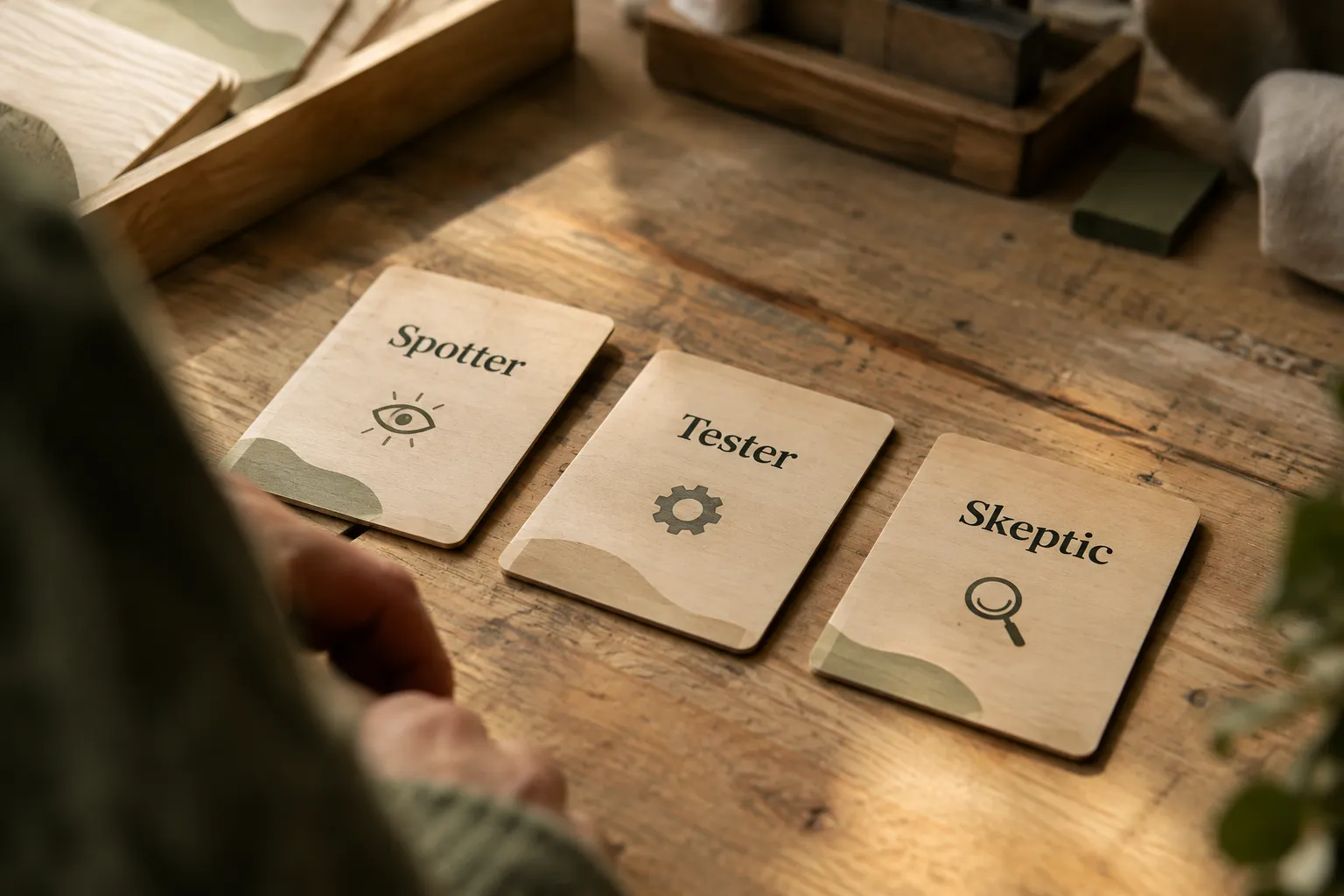
Not everyone needs to become an AI expert. You need three distinct figures: the one who spots problems, the one who tests solutions and the one who asks the uncomfortable questions.
One of the most common mistakes is thinking AI is a job for “techies.” In reality, AI projects that last need people who monitor automated workflows, check output quality and flag when something goes wrong. These roles are often more critical than the people who build the prompts.
A practical method that emerged at the MarTech Conference is the Showcase Showdown: small cross-functional groups that work together every month with three rotating roles.
- 1 · The SpotterFinds the bottlenecksMaps the points in the daily workflow where the team loses the most time or gets stuck.
- 2 · The TesterExperiments with AI solutionsTries tools or automations to solve the problem the Spotter identified.
- 3 · The SkepticAsks the uncomfortable questionsChecks risks, gaps and output quality. Validates before the team adopts the solution.
- 4 · The TeamShares and rotatesAt the end of the month, you share what worked, what didn't and what needs to change. Then you swap roles.
| Role | Who can do it | Value for the company |
|---|---|---|
| Spotter | Anyone who knows internal processes well | Avoids automating the wrong step |
| Tester | Whoever is most comfortable with AI tools | Brings concrete, measurable solutions |
| Skeptic | Someone with critical thinking who knows the brand | Protects quality, compliance and reputation |
| Monitor | Whoever manages operational workflows | Keeps AI systems running over time |
How do you find the real bottleneck before introducing an AI tool?
You map the real workflow together with the people who live it every day. It's the only way to avoid automating the wrong step.
A concrete example from the MarTech Conference: an email campaign takes 20 minutes to write and three days for legal and manager approvals. Using AI to cut the writing to 2 minutes changes nothing about the total time. The bottleneck is approval, not writing.
This mistake is more common than you'd think. Before choosing a tool, it's worth sitting down with the people who do the work and drawing the workflow step by step. Often you'll find redundant steps that can be eliminated entirely, without even needing AI.
To dig deeper into building AI workflows that combine efficiency and human oversight, it's also worth reading how to define AI roles in the marketing team and why many companies see no profit from AI and how to fix it.
| Workflow | Slow step | Where people think of using AI | Where it's really worth using it |
|---|---|---|---|
| Email campaign | Approvals (3 days) | Copywriting | Managing the approval process or automatic reminders |
| Monthly reporting | Collecting data from multiple sources | Writing the report | Data aggregation and normalization |
| Order management | Manual availability check | Customer reply | Automatic real-time stock check |
| Customer onboarding | Filling in repetitive forms | Welcome communications | Automatic pre-filling of known data |
How do you build psychological safety in the team without sounding preachy?
The leader has to go first: publicly admitting you don't know something about AI lowers the embarrassment threshold for everyone else.
Psychological safety — the freedom to ask questions, make mistakes and learn without fear of judgment — isn't created with a motivational speech. It's created with concrete behaviors, repeated over time.
The starting point is simple: the manager says “I don't know yet” in front of the team when AI comes up. That signal is worth more than any written policy. It tells people they don't have to pretend to know.
A second step is separating training from performance reviews. If people know that admitting gaps could cost them a bad review, they'll never admit them. AI training should be a protected space, not a test.
What does 'agentic deference' mean, and why is it useful for SMEs?
It means AI gains autonomy only after proving it's reliable on limited tasks. People keep strategic control, while AI does the routine work.
“Agentic deference” is the term used by Tinuiti, an American agency, to describe its approach: it starts by connecting advertising data to an AI environment that answers questions in plain language. Marketers ask, AI answers. No budget is handed over autonomously to an automated system.
Only when the system proves reliable on specific tasks does its scope of action expand. It's an approach that works well for Italian SMEs too: start small, measure, scale.
To understand how AI agents actually work in workflows, it's useful to read how Claude Skills automates the team's repetitive workflows and the technical guide to GPT-5.6 for AI agents.
How do you structure AI governance without blocking experimentation?
Rules should be a point of reference, not an obstacle. A few clear guidelines on brand voice, content accuracy and who approves what are enough.
AI governance, meaning the rules that define how your company uses AI tools, scares a lot of managers because it sounds like bureaucracy. In reality, governance that is light but clear gives your team the freedom to experiment without fear of making a serious mistake.
A practical framework that came out of the MarTech Conference is called Ready to Represent: before any AI output goes live, the team answers one question only: "Would you put your name on it?" If the answer is no, it gets revised. If it's yes, it gets published.
If your company deals with more serious compliance risks, such as personal data or regulated sectors, it's also worth reading the security and compliance risks of autonomous AI models.
| Governance area | What to define | Who is responsible |
|---|---|---|
| Brand voice | Tone, style and words to avoid in AI outputs | Marketing / Brand manager |
| Content accuracy | Review process before publication | Editor or content lead |
| Data and privacy | What data can be uploaded to AI tools | IT / DPO (data protection officer) |
| Approvals | Who gives the green light for each type of output | Department manager |
| Rule updates | How often the guidelines are reviewed | Enablement lead or HR |
How do you move from one-off training to continuous AI learning?
You assign responsibility for keeping up to date to one person or a small group, who filters the news and turns it into practical guidance for the rest of the team.
The problem with AI training isn't a lack of content. It's the speed at which the tools change. A course taken six months ago is already partly outdated. Expecting everyone to keep up on their own, on top of their regular work, is a road to burnout.
The solution is to shift the model: from a "training event" to an "update flow." Someone, an enablement lead in large companies or a team lead in SMEs, is explicitly responsible for following what's new and turning it into practical bite-sized updates for the team. Not every day: structured monthly updates are enough.
According to the Osservatorio Innovazione Digitale nelle PMI of the Politecnico di Milano, only 7% of Italian SMEs have launched structured AI training programs. And 76% have neither invested nor plan to. That means that if you start now, you gain a real competitive advantage.
- 1 · Month 1Map workflows and rolesIdentify the processes where AI can truly help and assign the Spotter, Tester and Skeptic roles.
- 2 · Month 2Launch a first limited experimentPick one workflow, one tool, one small team. Measure the results before scaling.
- 3 · Month 3Share the results with the whole teamShow what worked and what didn't. This lowers the fear barrier for those who haven't tried yet.
- 4 · Month 4+Build continuous learningAppoint an enablement lead. Schedule short, practical monthly update sessions.
What mistakes do companies make most often when introducing AI?
There are three common mistakes: automating the wrong step, training only the "tech people," and not assigning clear governance responsibilities.
Many companies buy the right tool and use it in the wrong place. Others train only those who are already enthusiastic and leave the skeptics behind, losing exactly the people who might ask the most useful questions.
| Common mistake | Why it happens | How to avoid it |
|---|---|---|
| Automating the wrong step | The tool is chosen before the workflow is mapped | Map the real bottleneck with the people who do the work |
| Training only power users | You focus on those already ahead and ignore those behind | Use rotating roles to involve every profile |
| No written governance | People assume rules slow down experimentation | Write 3-5 essential guidelines and assign an owner |
| One-off training | You run one course and think the job is done | Schedule short, practical monthly updates |
| Managers who don't use AI | The team doesn't see the example from the top | The manager uses AI in front of the team and admits their own limits |
| Measuring only adoption, not results | You count who uses the tool, not what it produces | Define output KPIs before launch |
How do I know if my AI adoption plan is really working?
You measure three things: how many people use the tool regularly, how much time they save on target workflows, and whether the quality of the output is acceptable without heavy revisions.
Adoption is measured, not guessed. Before launching any AI tool, define three or four concrete indicators to check every month. To learn more about building a system to measure AI ROI, read how to measure AI ROI in your company before you spend.
| Indicator | What it measures | Positive signal | Red flag |
|---|---|---|---|
| Active usage rate | % of the team using the tool at least once a week | Above 60% after 60 days | Below 30% after 30 days |
| Time saved on the target workflow | Minutes/hours recovered on the chosen process | Measurable, stable reduction | No change from before |
| AI output revision rate | % of outputs that need substantial corrections | Below 20% | Above 50%: the prompt or workflow needs rethinking |
| Training participation | % of the team attending the monthly updates | Above 70% | Below 40%: the format isn't working |
| Problem reports | Number of errors or risks flagged by the Skeptic | Regular, handled reports | Zero reports: nobody is checking |
So, is it worth building an AI change management plan for your company?
Worth it if you've already chosen one or more AI tools but adoption is stalled, or you're about to launch something new and want to avoid internal resistance. A structured plan, even a light one, makes the difference between a tool that gets used and one that gets abandoned.
A middle ground: you're an SME with fewer than 20 people and don't have an active AI workflow yet. Start with a small experiment and a single point-of-reference role. You don't need a formal plan, but you do need someone to guide the process.
Not yet if you're still evaluating which AI tool to adopt and don't have a clear use case yet. First define the problem you want to solve, then build the adoption plan.
How we see it at SHM
For us, AI is the means, and the people who work with it every day are the end. We've seen too many projects stall, not because of technological limits, but because no one had prepared the team to change the way they work. Technology can be installed in an afternoon; people's trust takes months to build.
Picture a manufacturing company that wants to automate the handling of after-sales support requests. The right tool exists. But if the support team doesn't understand why their workflow is changing, doesn't have a clear role in the new process and doesn't see measured results, the tool will sit unused. Change management isn't optional: it's what makes the investment worthwhile.
If you're looking at how to introduce AI into your organization in a structured way, our strategic AI integration and AI training for companies services are designed for exactly this journey. If you'd rather start with automating operational processes, there's also our business process automation service. You'll find all our articles on AI adoption, agents and automation in the AI and process automation section.
Frequently Asked Questions
You start by mapping your workflows: pick a repetitive process and ask the team where they lose the most time. Only then do you look for the right tool for that specific problem. Starting from the tool and then looking for a use is the most common mistake.
With a limited experiment on a single workflow, the first signs show up in 30-60 days. Stable, measurable results usually arrive after three or four months, once the team is comfortable with the new way of working and governance is running smoothly.
The skeptic is an asset, not a problem. That's exactly why the Skeptic role exists in the Showcase Showdown method: the person asking the hard questions protects quality and compliance. The problem isn't resistance in itself, but silent resistance that never comes out in the open.
Not necessarily. In SMEs, AI change management can be set up with internal resources: a dedicated team lead, short monthly sessions and a role rotation method. The main cost is time, not tools.
You move from an event-based model (one course, then nothing) to a continuous one: someone has the explicit job of following new developments and turning them into practical monthly updates. You don't need to follow everything, just the news that matters for the workflows already running in your company.
You analyze the why: often, people who don't use the tool haven't had a proper introduction or don't see a concrete benefit in their own specific job. The rotating roles method helps involve even those starting from zero, because it doesn't require any prior technical skills.
AI doesn’t fail because of the tools. It fails when we forget that people are the ones who use it.
Related articles
Discover more articles exploring similar topics, selected to offer you a more complete and stimulating perspective. Each piece of content is carefully chosen to enrich your experience.