

- Marketing AI tools: what really changes in 2026
- How to choose the right AI marketing tools for your company
- AI marketing tools for automation: efficiency and scalability
- HubSpot AI: automation and integrated funnel management
- Salesforce AI: Einstein/Agentforce: large-scale prediction and automation
- ActiveCampaign AI: automated campaign personalization
- Zapier AI: business process integration and automation
- AI marketing tools for communication: content, copy, and customer interaction
- Generative AI: content creation and strategic support
- Jasper AI: conversion-oriented copywriting
- Copy.ai: rapid generation of marketing content
- Surfer SEO: content optimized for rankings
- Notion AI: content organization and production
- AI marketing tools for advertising: performance, targeting, and optimization
- Google Ads AI: campaign automation and optimization
- Meta Advantage+: automated campaigns and dynamic targeting
- AdCreative.ai: ad creative generation
- Persado: data-driven persuasive language
- Albert AI: autonomous ad campaign management
- Integrating AI marketing tools and the role of SHM Studio in implementation
- Most common FAQs about AI marketing tools
- Comparison tables for AI marketing tools dedicated to automation, communication, and advertising
AI marketing tools are becoming a central component in business activities because they allow data, content, and campaigns to be managed in a coordinated and up-to-date manner. This article analyzes how they work and how they impact the main areas of marketing: automation, communication, and advertising. It explains how artificial intelligence intervenes in managing contact flows, content production, and campaign optimization, offering a concrete overview of the changes underway.
The guide delves into the main AI marketing tools of 2026, including HubSpot, Salesforce, ChatGPT, Jasper, Google Ads, and Meta Advantage+, describing their functions and uses. It also provides useful criteria for choosing the most suitable platforms based on business needs, avoiding dispersion and overlaps.
A specific focus is dedicated to the integration between tools, a fundamental element for achieving consistent results over time. The article shows how to connect data, content, and campaigns within a single system, highlighting the role of SHM Studio in implementing and managing AI marketing tools to build effective and sustainable activities.
The exponential growth of touchpoints between brand and consumer has totally changed the workflow management of AI Agencies and communication specialists who, in 2026, need almost instant data processing capacity. The new AI marketing tools available to professionals act like the central nervous system of business activities, allowing coordination of information volumes that exceed the analysis capabilities of traditional teams. The speed at which markets absorb new trends requires the adoption of self-learning systems, where data accuracy becomes the only real differentiating factor available to businesses and brands.
Integrating these systems into agency operations , companies and SMEs brings benefits that are obvious if you look at three key pillars:
- Precision execution on a large scale: The algorithms spot trends in milliseconds, giving you the speed to turn any market shift into an instant win for your positioning and brand identity.
- Personalization architecture: each user receives an experience modeled on their browsing behavior, ensuring message relevance that drastically increases company loyalty and engagement.
- Evolution of business processes: Workloads are handled by computing engines that scale right along with the business, making sure growth isn't held back by tech or human limits.
The most modern AI marketing tools guide businesses toward a prediction-based management, where automation, communication, and advertising blend into a single entity capable of boosting the value of every single interaction.
SHM Studio, as an AI Agency , supports its clients in integrating AI marketing tools, building ecosystems where data, content, and campaigns interact frictionlessly. From platform configuration to continuous optimization, we develop solutions designed to make AI truly usable and sustainable over time.
Marketing AI tools: what really changes in 2026
The artificial intelligence applied to marketing in 2026 is already having a strong impact on sales and customer acquisition strategies, thanks to the introduction of a setup where info gathered along the customer journey is used to keep tweaking messages and audiences. This is a profound transformation of traditional marketing logic, shifting from management based on rigid planning to a "live" model that adapts over time based on results and user behavior while browsing.
The impact of these technologies extends to every phase of the buying journey undertaken by potential customers and at the same time redefines the concept of interaction between business and digital user : the ideal customer journey, from first contact to the desired action, is instantly modeled thanks to LLMs (Large Language Models) and predictive analytics. This way, it becomes possible to offer specific answers for every doubt or need detected by the system, while potential drop-off points in the funnel are identified and enclosed in recurring patterns, allowing for continuous improvement of integrated strategies and constant control over budgets and communications.
AI marketing tools make this type of management possible because they connect data collection, analysis, and action all inside the same system , promoting more continuous activity control, with updates that follow the actual trend of interactions between the public and the company.
How to choose the right AI marketing tools for your company
More than the absence of technology, the new risk for businesses is called information and technical overload, meaning the inefficient use of too many tools. Choosing the right AI marketing tools, in this sense, is just as important as their implementation.
- The first fundamental criterion is integration with your existing tech stack: an isolated tool, no matter how powerful, won't improve the overall flow of a business much. The real power, instead, lies in AI's ability to "talk" with the CRM, ERP, and data analysis platforms already in use, creating a smooth and two-way flow of information.
- Another factor is scalability combined with ease of use. In 2026, the best AI marketing tools are indeed those that offer "hidden complexity": extremely sophisticated algorithms with intuitive interfaces that allow marketing teams to act without having to constantly depend on the IT department.
At this point, it is also important to distinguish between:
- Vertical tools: highly specialized systems for a single technical task, such as advanced copy optimization or predictive analysis of purchasing behavior.
- All-in-one platforms: complete setups built to handle the whole value chain and centralize every step of communication and marketing.
The choice depends on the company's digital maturity and the expected ROI: every investment in AI marketing tools must be justified by clear metrics, whether it's reducing operating costs or increasing conversion rates, ensuring that technology always serves the strategy and never the other way around.
AI marketing tools for automation: efficiency and scalability
AI-driven automation boosts business productivity by freeing professionals from repetitive tasks and enabling large-scale process management. The AI marketing tools designed for these applications step in in lead management and maintaining relationships with existing customers. Their efficiency increases thanks to workflows that activate autonomously, ensuring a constant brand presence on various platforms without requiring constant manual monitoring by the team.
When it comes to automation, mixing in smart systems totally flips how we manage time and resources. Contact sequences educate the potential customer by providing exactly the information needed for conversion at the moment when the propensity to buy is highest. At the same time, automatic updating of customer profiles allows future needs to be anticipated based on the history of past interactions.
Use the AI marketing tools automating these types of procedures greatly favors the relationship between brand and customer, as every contact can receive high-quality treatment systematically and automatically.
Let's now look at a selection, operated by SHM Studio, of the best AI marketing automation tools on the market
HubSpot AI: automation and integrated funnel management
HubSpot integrates an AI system within the CRM that works on contact data, interactions, and commercial activities.
The main features include automatic content generation, lead qualification, and the construction of communication sequences based on user behavior. For example, AI analyzes email opens, website visits , form submissions, and campaign interactions, automatically updating contact statuses and suggesting potential next steps.
The system also connects marketing and sales teams in one single environment , where all information is updated in real-time. This allows for the reduction of manual activities related to segmentation, follow-up, and communication flow management, keeping data and activities aligned without continuous intervention.
Salesforce AI: Einstein/Agentforce: large-scale prediction and automation
Salesforce Einstein uses predictive models applied to CRM data to process lead scores, predict conversion probabilities, and suggest targeted commercial actions based on the target audience.
The system chews through tons of past data and user behavior, turning it into actionable insights for closing sales and generating leads.
Agentforce instead introduces more advanced automation levels, with agents capable of executing task sequences such as data updates, sending communications, and decision support.
The whole system is based on a continuous reading of the data within the platform, which are reworked to optimize priorities, assignments, and intervention timelines.

ActiveCampaign AI: automated campaign personalization
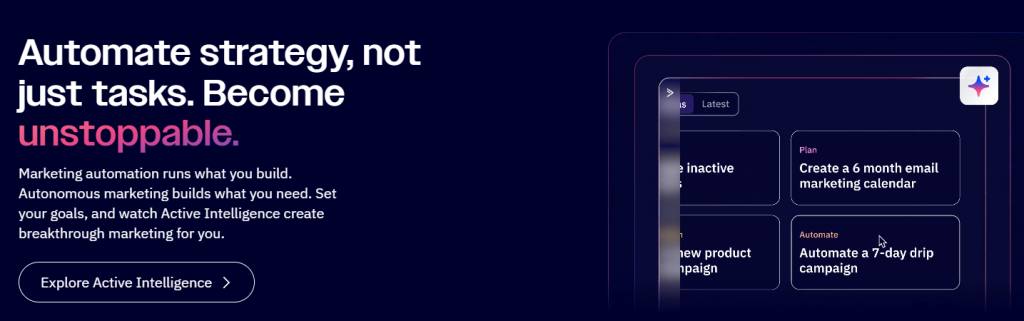
ActiveCampaign uses artificial intelligence primarily for email communication management and contact segmentation, as well as providing tools for Marketing automation .The system analyzes user behavior to dynamically change message sequences, adapting both content and timing.
AI jumps in to craft email subject lines, set up automations, and fine-tune communication flows. The gathered info is used to keep segments fresh, moving contacts between different lists based on how they interact.
This means you can keep your communication flowing and up to date without having to manually mess with every single campaign.
Zapier AI: business process integration and automation
Zapier makes it super easy and intuitive to link up different platforms and automate workflows without needing to code , using increasingly smart logic thanks to AI.
In practice, it allows you to trigger automatic actions across CRM, email, advertising, and analytics tools. Artificial intelligence helps build smoother workflows by suggesting links and boosting day-to-day productivity.
It is, therefore, a key tool for building an integrated ecosystem . For many companies and SMBs , represents the necessary step to transform a series of isolated tools into a coordinated and manageable workflow.

AI marketing tools for communication: content, copy, and customer interaction
Creating an effective corporate narrative today requires producing multi-channel materials that maintain a consistent brand voice. The AI marketing tools dedicated to communication support the generation of texts, graphics, and videos by analyzing audience preferences and suggesting the most engaging visual and textual solutions. Technology acts as an accelerator of corporate expressive capacity, providing analysis that allows the message to be refined even before its publication, ensuring that every word is aligned with real brand values .
Chatting with your audience gets a boost from advanced conversational systems that totally step up the customer service game:
- Creative synthesis and multi-channel adaptation: content generation is optimized for each individual platform extremely quickly, ensuring that the message maintains its persuasive power in both short formats and extended technical insights.
- Predictive dialogue systems: The virtual assistants and the AI chatbot handle complex conversations by anticipating user objections and offering solutions that boost the company's perceived expertise.
- Tone of voice governance: advanced algorithms constantly verify that every communication produced respects strict stylistic parameters, eliminating the discrepancies typical of manual production distributed among multiple teams.
The use of AI marketing tools in communication ensures an authoritative and constant presence, allowing the brand to establish a deep relationship with its users through content that always appears current and tailored to the specific needs of the recipients.
Generative AI: content creation and strategic support
Among the most popular AI marketing tools, ChatGPT, Gemini, Perplexity, and similar software have become fundamental support for content production and communication task management. They are mainly used to generate texts, develop ideas, and structure materials quickly and accurately.
Whether it is create editorial content, write emails, or help define messaging and positioning, These platforms are super advanced, but they still need a lot of human oversight to double-check sources and keep info accurate. with hallucination phenomena still very widespread.
Although not yet perfect, these tools are now essential for increasing productivity while maintaining consistency, especially when supported by clear guidelines on tone of voice and objectives.

Jasper AI: conversion-oriented copywriting
Jasper is specifically designed for marketing and focuses on creating content with conversion goals, offering templates and structures designed for campaigns, landing pages, emails, and advertising.
artificial intelligence supports writing while maintaining brand consistency and adapting the tone based on context. This makes it one of the most effective AI marketing tools for those working on funnels and performance.
It is particularly useful, for example, when you need to produce content systematically , while maintaining quality and structure. The approach is less generic compared to other tools and more oriented toward measurable results.

Copy.ai: rapid generation of marketing content
Copy.ai it stands out for speed and ease of use. Allows you to generate texts for different channels ( Social , emails, blogs) starting from essential inputs, cutting down production time.
This AI is specifically designed to provide rapid variations, facilitating testing and iteration phases, making it particularly valuable in situations where content needs to be produced and validated quickly.
Among AI marketing tools, it's a solid choice for teams handling high volumes who need plenty of flexibility and adaptability. Like any generative AI, it doesn't replace a well-thought-out content strategy, but it gives serious backup to the actual execution.

Surfer SEO: content optimized for rankings
Surfer SEO introduces a data-driven approach to content production, analyzing SERPs and providing detailed guidelines to build texts in line with what works on search engines .
AI suggests structure, keywords, semantic density and optimizations, allowing for greater precision. This makes Surfer SEO one of the most useful AI marketing tools for those focused on organic visibility.
It doesn't just improve existing texts, it guides content creation right from the start , resulting in more mindful production oriented toward positioning.
Notion AI: content organization and production
Notion AI combines info management and writing support, this way making it possible to centralize documents, editorial plans, and content, while adding AI features to speed up production.
Artificial intelligence helps synthesize, reorganize, and develop texts , making teamwork smoother across all creative departments. This is especially useful in settings where communication involves multiple people, like SEO specialists, copywriters, editors, and communication and marketing experts.
Among AI marketing tools, it is one of the most effective for improving internal processes.
AI marketing tools for advertising: performance, targeting, and optimization
The artificial intelligence-based advertising represents the peak of technical precision applied to sales, where every fraction of the budget is allocated based on advanced calculations. AI marketing tools for advertising, already widespread, eliminate the uncertainties typical of manual management, identifying the most promising audience segments through the analysis of thousands of cross-referenced behavioral variables. . This leads to drastic cost optimization for companies, as ads are shown to those who show real interest or a latent need detected by the system.
The advertising optimization leverages calculation functions that exceed human monitoring capabilities, and as the years go by and technology develops, they will become increasingly precise. The automatic adjustment of bids in advertising auctions happens in real-time to maximize the return of each impression, while the instant assembly of different ads allows showing each user the most effective combination of images and texts for their profile.
Relying on AI tools in the advertising sector, it ensures secure capital management, where technology works to find new growth opportunities and refine the performance of every single promotional action on a large scale.
Google Ads AI: campaign automation and optimization
Google Ads uses smart tech that checks tons of live data from your running campaigns right away , such as clicks, conversions, views, and user behavior, and reprocesses them to automatically update offers, budget allocation, and audience selection.
Through features like Smart Bidding and Performance Max , the platform isn't just about handling single settings, instead builds dynamic combinations of creativity, targeting, and placement that are continuously tested and optimized. So, AI jumps into the whole campaign cycle, tweaking choices based on what actually happens, with the goal of boost conversions and the overall efficiency of advertising activities without the need for constant manual intervention.
Meta Advantage+: automated campaigns and dynamic targeting
Meta Advantage+ manages advertising campaigns on Facebook and Instagram through automated systems that use users' behavioral data to define audiences, placements, and creative distribution.
The system tests simultaneously different ad combinations and dynamically assigns budget to the variants that generate the best performance, continuously updating campaigns based on collected signals such as interactions, views, and conversions.
The whole process is based on a model that cuts down on manual setup and leaves the AI to handle day-to-day optimization.

AdCreative.ai: ad creative generation
AdCreative.ai is designed to produce visual assets and copy for advertising campaigns. AI analyzes performance data and generates content already optimized for conversion.
The system uses models that analyze conversion data to build ads that can achieve better results, creating multiple versions of the same content to allow for testing and comparison.
Content is then evaluated based on data collected from campaigns and optimized over time, making the advertising asset production process faster and more results-oriented compared to traditional manual creation.
Persado: data-driven persuasive language
Persado focuses on optimizing language in marketing communications: analyzes large volumes of data to identify which words and structures generate the most engagement.
AI creates conversion-oriented messages, tailoring tone and content to the target audience. This makes it an advanced tool for email campaigns, advertising, and direct communication.
It's one of the most interesting AI marketing tools for those working on message quality, with its focus not on quantity, but primarily on language effectiveness.
Albert AI: autonomous ad campaign management
Albert AI handles multi-channel ad campaigns autonomously , constantly analyzing performance data and intervening on budget allocation, targeting, and creativity without the need for continuous manual intervention.
The system tests different ad variations, checks the results, and automatically shifts budget to the top performers while updating campaigns live.
The AI then coordinates the entire advertising cycle, from the testing phase to the optimization phase, working on multiple platforms simultaneously and adapting decisions based on signals collected during campaign execution.
Integrating AI marketing tools and the role of SHM Studio in implementation
The secret isn't the number of tools you use, but how well they talk to each other and fit into your current setup.
The integration starts by defining data flows : what information is collected, where it is stored, and how it is used at different stages of the work. From here, a structure is built that connects CRM, automation, content production, and advertising, avoiding manual steps that slow down task updates.
In this scenario, SHM Studio acts as an AI agency in the design and implementation of AI marketing tools, working on building connected and usable environments over time. The goal is to make the platforms part of a single system, where each element contributes to the continuous updating of activities.
Main activities include:
- Mapping available data : analysis of sources (CRM, advertising, analytics, content) and definition of how they connect to each other
- Setting up integrations between platforms : connection between automation, content management, and advertising tools to ensure real-time updates
- Workflow structuring : defining automated sequences triggered by specific behaviors, events, or signals
- Continuous system optimization : reading data generated by AI marketing tools and updating operational logic
- Alignment between content and campaigns : coordination between editorial production and ad distribution to keep messaging consistent
This approach allows AI marketing tools to be used not as standalone solutions, but as part of an ecosystem that evolves with the company's data and needs.
Contact us for a consultation and to discover what AI marketing tools can really do for your business.
Most common FAQs about AI marketing tools
1. How do you connect different AI marketing tools without creating overlaps?
The key isn't adding more tools, but preventing them from collecting and managing the same data separately. To properly connect marketing AI tools, you need to establish a primary source for each data type, like your CRM for contacts or your ad platform for performance. From there, you build connections between systems so information is updated once and then shared with other tools. Without this logic, you end up with duplicates that make it hard to read results and update tasks consistently.
2. How do AI marketing tools handle incomplete or unstructured data?
AI marketing tools are designed to work even with imperfectly organized data, but the quality of the output directly depends on the quality of the available information. When data is incomplete, AI tends to generalize or rely on less precise patterns, affecting segmentation and personalization. Some tools integrate data enrichment functions, which automatically complete profiles with external data, but this doesn't replace orderly internal management. The best results are achieved when data is consistent, up-to-date, and collected with a precise logic.
3. What is the current limit of AI marketing tools in content personalization?
Personalization works well when it's based on clear, repeated behaviors like clicks, purchases, or frequent interactions. AI marketing tools can use these signals to tailor content and communications, but they face limitations when data is scarce or not very meaningful. Furthermore, automatic personalization can produce consistent but uninspired content if not guided by defined editorial guidelines. The limitation isn't technical, but rather concerns the ability to integrate data and content intentionally, avoiding generic communications even when they are personalized.
4. What happens when you use too many AI marketing tools together?
Too many tools often lead to data fragmentation and a loss of control over activities. When each platform handles a part of the work without being connected to others, it becomes difficult to have a clear view of the results. AI marketing tools work best when selected based on specific needs and integrated with each other. Increasing the number of tools without a strategy leads to duplication, inconsistent data, and difficulties in daily management.
5. Do AI marketing tools work the same way across all industries?
Nope, how much they help depends on your business and data. Fields with loads of customer actions, like e-commerce or digital services , allow AI marketing tools to work with greater precision. In areas with long sales cycles or little data, AI has less information to draw on and requires more careful configuration. This doesn't mean it's not useful, but that it needs to be adapted to the context, with consistent expectations based on the available data.
6. How does the role of the marketing team change with the introduction of AI?
Work shifts from direct task management to supervising and configuring tools. AI marketing tools reduce the time spent on repetitive operations but require attention in defining objectives, content, and parameters. The team becomes responsible for the quality of inputs and data interpretation, rather than manual execution. This requires different skills, related to data reading and system management.
Comparison tables for AI marketing tools dedicated to automation, communication, and advertising
1. Automation
| Tool | Key feature | Companies it is best suited for |
| HubSpot AI | Integration between CRM, automations, and content based on contact data and interactions | SMEs and growing companies that want to centralize marketing and sales |
| Salesforce Einstein / Agentforce | Predictive analysis and advanced data management with large-scale automations | Large companies and organizations with heavy data volumes |
| ActiveCampaign AI | Email automation and dynamic segmentation based on user behavior | SMBs, e-commerce, and companies focused on email marketing |
| Zapier AI | Connection and automation between different tools without technical development | Businesses of any size with a fragmented digital stack |
2. Communication
| Tool | Key feature | Companies it is best suited for |
| ChatGPT | Generation and reworking of textual content across different formats | Companies of any size that produce content on an ongoing basis |
| Jasper AI | Creation of structured copy for marketing and conversion-focused campaigns | Marketing teams and companies focused on performance and funnels |
| Copy.ai | Quick production of content variants for testing and multi-channel distribution | Teams working on high volumes of content |
| Surfer SEO | Content optimization for search engine positioning | Companies focusing on SEO and organic content |
| Notion AI | Content management and production within a centralized environment | Teams managing content and shared documentation |
3. Advertising
| Tool | Key feature | Companies it is best suited for |
| Google Ads AI | Automatic optimization of campaigns, offers, and budget distribution | Companies investing in Google advertising and looking for scalability |
| Meta Advantage+ | Automated management of social campaigns with dynamic targeting | Companies working on Facebook and Instagram Ads |
| AdCreative.ai | Image and text generation for ads | Marketing teams and companies producing lots of ad assets |
| Persado | Optimization of advertising language based on data and performance | Structured companies working on high-conversion copy |
| Albert AI | Autonomous management of ad campaigns across multiple channels | Companies with high advertising investments and complex structures |
Related articles
Discover more articles exploring similar topics, selected to offer you a more complete and stimulating perspective. Each piece of content is carefully chosen to enrich your experience.